Resources

Hello, tech enthusiasts! As we dive into 2024, it’s time to look at the latest trends that are shaping the world of software development. Whether you’re a seasoned developer, a budding coder, or just someone interested in the tech world, staying updated with these trends is crucial. Let’s explore the key software development trends that are set to dominate 2024.

1. Artificial Intelligence and Machine Learning

Artificial Intelligence (AI) and Machine Learning (ML) have been buzzwords for a while, but their importance continues to grow. In 2024, we can expect even more sophisticated AI and ML applications. These technologies are being integrated into various software solutions to provide smarter, more intuitive user experiences.

Why This Matters

  • Automation: AI can automate repetitive tasks, allowing developers to focus on more complex problems.
  • Enhanced User Experience: Personalized recommendations and intelligent features enhance user satisfaction.
  • Improved Decision Making: AI-driven analytics provide deeper insights, helping businesses make better decisions.

Key Examples

  • AI-powered Code Assistants: Tools like GitHub Copilot are getting better at understanding natural language, making coding more accessible.
  • Smart Applications: AI is being used to develop apps that can predict user behavior, improve security, and optimize performance.

2. Low-Code and No-Code Development

The need for software solutions is outpacing the availability of skilled developers. Enter low-code and no-code platforms, which enable users to create applications with minimal coding knowledge.

Why This Matters

  • Speed: These platforms accelerate the development process.
  • Accessibility: More people can create software, democratizing development.
  • Cost-Effective: Reduces the need for large development teams.

Key Examples

  • OutSystems and Mendix: Leading platforms that allow rapid development with drag-and-drop interfaces.
  • Bubble: A no-code tool that lets users create complex web applications without writing code.

3. DevOps and GitOps

DevOps practices have been crucial in enhancing collaboration between development and operations teams. In 2024, GitOps is taking this a step further by using Git repositories as the single source of truth for deployment automation.

Why This Matters

  • Consistency and Reliability: GitOps ensures that deployments are consistent and reliable.
  • Efficiency: Streamlines CI/CD (Continuous Integration/Continuous Deployment) pipelines.
  • Improved Collaboration: Enhances team collaboration through better version control.

Key Examples

  • ArgoCD and Flux: Popular GitOps tools that help manage Kubernetes clusters and other infrastructure.

4. Edge Computing

Edge computing is about processing data closer to where it is generated rather than in a centralized data center. This trend is gaining traction due to the rise of IoT (Internet of Things) devices and the need for real-time data processing.

Why This Matters

  • Reduced Latency: Faster processing times are critical for applications like autonomous vehicles and smart cities.
  • Better Security: Data is processed locally, reducing the risk of breaches.
  • Cost Savings: Reduces the amount of data that needs to be sent to the cloud.

Key Examples

  • AWS IoT Greengrass and Azure IoT Edge: Platforms that extend cloud capabilities to local devices.

5. Microservices Architecture

Microservices architecture divides applications into smaller, autonomous services that can be developed, deployed, and scaled independently. This trend continues to gain momentum as it offers greater flexibility and scalability.

Why This Matters

  • Scalability: Services can be scaled independently based on demand.
  • Resilience: Failure of one service doesn’t affect the entire application.
  • Flexibility: Various teams can simultaneously work on separate services.

Key Examples

  • Kubernetes: Widely used for managing microservices.
  • Docker: Helps containerize applications, making them more portable and scalable.

6. Quantum Computing

Quantum computing is still in its early stages, but it holds the promise of solving problems that are currently impossible for classical computers. In 2024, we can expect more advancements and practical applications of quantum computing.

Why This Matters

  • Computational Power: Can solve complex problems much faster than traditional computers.
  • Innovation: Opens up new possibilities in fields like cryptography, material science, and complex simulations.

Key Examples

  • IBM Quantum and Google Quantum AI: Leading the charge in making quantum computing more accessible.

7. Cybersecurity Enhancements

As software becomes more sophisticated, so do the threats. Cybersecurity remains a top priority, and in 2024, we can expect more advanced security measures integrated into software development.

Why This Matters

  • Protection: Safeguards sensitive data from breaches and attacks.
  • Compliance: Helps businesses adhere to regulatory requirements.
  • Trust: Builds user trust through robust security practices.

Key Examples

  • Zero Trust Architecture: A security framework mandating thorough authentication for every individual and device seeking resource access.
  • AI-Driven Security: AI and ML are being used to detect and respond to threats in real-time.

8. Sustainability and Green Computing

Sustainability is becoming a critical consideration in software development. Green computing aims to reduce the environmental impact of technology through efficient resource use and eco-friendly practices.

Why This Matters

  • Environmental Impact: Reduces the carbon footprint of software and hardware.
  • Cost Savings: Energy-efficient solutions can reduce operational costs.
  • Corporate Responsibility: Meets the growing demand for sustainable business practices.

Key Examples

  • Green Data Centers: Using renewable energy sources and optimizing energy use.
  • Sustainable Coding Practices: Writing code that consumes less energy and resources.

9. 5G Integration

The rollout of 5G networks is set to revolutionize mobile and web applications with faster speeds and lower latency. This trend will enable new possibilities in areas such as augmented reality (AR), virtual reality (VR), and IoT.

Why This Matters

  • Speed: Faster internet speeds enhance user experiences.
  • Innovation: Enables new applications that were previously not feasible.
  • Connectivity: Improves the performance of connected devices.

Key Examples

  • Smart Cities: Enhanced connectivity for better urban management.
  • AR/VR Applications: More immersive and responsive experiences.

10. Ethical AI and Responsible Tech

As AI and other advanced technologies become more prevalent, there is a growing emphasis on ethical considerations. Responsible tech practices ensure that these technologies are developed and used in ways that are fair, transparent, and accountable.

Why This Matters

  • Fairness: Avoids bias in AI algorithms.
  • Transparency: Builds trust through clear, understandable AI decision-making processes.
  • Accountability: Ensures developers and companies are responsible for their technologies’ impacts.

Key Examples

  • AI Ethics Frameworks: Guidelines and best practices for ethical AI development.
  • Regulations and Policies: Governments and organizations implementing rules to ensure responsible tech usage.

Conclusion

2024 is set to be an exciting year in the world of software development. From the continued rise of AI and ML to the practical applications of quantum computing, the future is brimming with possibilities. Keeping an eye on these trends will help you stay ahead of the curve and make informed decisions in your projects and career. Embrace these changes, continue learning, and get ready to innovate! If you need a software development company in the USA, contact YES IT Labs LLC.


What trends are you most excited about? Share your thoughts and let’s discuss how these trends can shape our tech landscape!


Code structure and best practices are the backbone of any successful software project. Whether you’re a seasoned developer or just starting out, adhering to a comprehensive checklist can make all the difference in the quality, maintainability, and security of your codebase. In this article, we’ll dive into a detailed checklist covering Swift-specific practices, code formatting, documentation, design patterns, and security measures. Let’s ensure your codebase is not just functional, but also robust and scalable.

Swift Code Structure and Best Practices Checklist

1. File and Project Organization

  • Separate Files: Keep each class, struct, enum, and protocol in its own file for clarity and organization.
  • Folder Structure: Organize files into logical folders based on features or functionality to enhance navigation.
  • Consistent Naming: Maintain descriptive and consistent names for files, classes, methods, and variables.
  • Xcode Groups: Utilize Xcode groups to mirror the folder structure, aiding in project management.

2. Code Formatting

  • Indentation: Use 4 spaces per indentation level for clear and consistent code readability.
  • Line Length: Keep lines of code within a reasonable length to enhance readability and maintainability.
  • Spacing: Employ consistent spacing around operators, commas, and within blocks for a neat appearance.
  • Braces: Place opening braces on the same line as the declaration for a concise code style.

3. Comments and Documentation

  • Single-line Comments: Use // for single-line comments to elucidate complex logic.
  • Multi-line Comments: Employ /* … */ for longer comments to provide detailed explanations.
  • Documentation Comments: Utilize /// to document public APIs and methods, adhering to Swift’s documentation syntax.
  • Comment on Intent: Focus comments on the intent and rationale behind the code, rather than stating the obvious.

4. Code Structure

  • Top-Level Declarations: Keep top-level declarations minimal in each file to enhance clarity and maintainability.
  • Methods and Properties: Group related methods and properties together for better organization. Utilize extensions to organize protocols and additional functionality.
  • Initialization: Ensure initializers are clear and concise, with properties initialized logically.
  • Access Control: Use appropriate access control levels to encapsulate and protect data, promoting data integrity.

5. Swift-Specific Practices

  • Optionals: Use optionals (?) and implicitly unwrapped optionals (!) judiciously, opting for safe unwrapping with if let or guard let.
  • Value Types: Prefer value types (structs, enums) over reference types (classes) when feasible to prevent unintended side effects.
  • Error Handling: Embrace Swift’s error handling mechanism with do, try, catch for robust error management.
  • Protocols and Extensions: Leverage protocols to define interfaces and extensions to augment functionality, promoting code reuse.

6. Design Patterns

  • MVC/MVVM: Choose a design pattern suitable for your project, such as MVC for UIKit or MVVM for SwiftUI, to enhance maintainability and scalability.
  • Delegation: Employ delegation for communication between classes, promoting loose coupling and modular design.
  • Singletons: Exercise caution when using the singleton pattern, reserving it for scenarios where a single, globally accessible instance is truly necessary.

7. Security

  • Data Protection: Ensure sensitive data is safeguarded, employing techniques like Keychain for secure storage of credentials.
  • Network Security: Prioritize HTTPS for network communications and validate server certificates to mitigate potential security risks.
  • Input Validation: Validate and sanitize all user inputs rigorously to thwart injection attacks and safeguard against vulnerabilities.

Conclusion

By adhering to this comprehensive checklist, you can elevate your codebase to new heights, fostering readability, maintainability, and security. Remember, the devil is in the details – every aspect of your code structure and practices contributes to the overall success of your project. So, the next time you embark on a coding endeavor, ask yourself: “Have I checked all the boxes?”

If you need an iOS developer for your iOS app, contact YES IT Labs.

Clean code is the foundation of maintainable, scalable, and robust software. In the fast-paced world of Android app development, adhering to clean code principles ensures your codebase remains comprehensible and easy to manage, even as your application evolves. Whether you’re an individual developer or part of an Android app development company, mastering these principles is essential. Let’s dive into six fundamental concepts: MVVM, Dependency Injection (DI), Single Responsibility Principle (SRP), Test-Driven Development (TDD), Function Structure, and Class Structure.

1. Model-View-ViewModel (MVVM)

The MVVM architecture pattern is a cornerstone of clean code in Android development. It separates the user interface logic from the business logic by introducing a ViewModel layer, promoting a clear division of responsibilities.

Breaking Down MVVM

  • Models: These represent your application’s data and business logic. They are responsible for managing the state and ensuring the data integrity of your application.
  • Views: These are the UI components that display data to the user and capture user input. Think of Activities, Fragments, and XML layouts in Android.
  • ViewModels: Acting as intermediaries between Views and Models, ViewModels expose data streams and handle user interactions. They provide a clean API for the UI to interact with the underlying data and business logic.

Why MVVM?

MVVM enhances testability and modularity. With this separation, you can test your business logic independently of the UI, making your codebase more maintainable and less prone to bugs.

2. Dependency Injection (DI)

Dependency Injection is a design pattern that improves the manageability and testability of your code by decoupling component creation from component usage.

Implementing DI in Android

In Android, popular DI frameworks like Dagger and Hilt are used to inject dependencies. These frameworks automatically provide the necessary dependencies to your classes, which:

  • Improves Testability: By injecting mocks or stubs during testing, you can isolate and test specific components.
  • Enhances Maintainability: Centralized dependency management makes it easier to update and manage dependencies across your project.

Example: Using Hilt for Dependency Injection

3. Single Responsibility Principle (SRP)

The Single Responsibility Principle states that a class should have only one reason to change, meaning it should focus on a single responsibility or purpose. This principle promotes cleaner, more understandable, and easier-to-maintain code.

Applying SRP in Android

Breaking down functionality into smaller, focused classes or methods:

  • Enhances Readability: Each class or method has a clear and singular purpose.
  • Facilitates Testing: Smaller units of code are easier to test and debug.
  • Promotes Reusability: Single-purpose classes and methods can often be reused across different parts of your application.

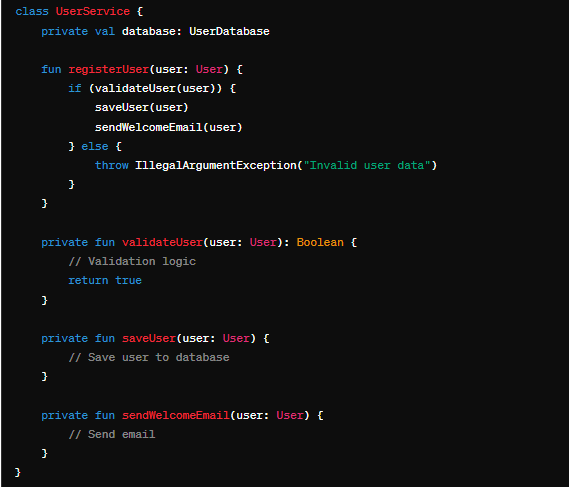
Example: Refactoring a Monolithic Class

Before applying SRP:

After applying SRP:

4. Test-Driven Development (TDD)

Test-Driven Development is a disciplined approach to software development where you write tests before writing the actual code. This ensures your codebase is always testable and that new features are well-defined and robust.

Benefits of TDD

  • Defines Clear Requirements: Writing tests first forces you to think through the requirements and expected behavior of your code.
  • Ensures Resilience: With a comprehensive test suite, you can confidently make changes without fear of breaking existing functionality.
  • Improves Code Quality: TDD encourages simpler and more modular code, as complex code tends to be harder to test.

Example: A Simple TDD Workflow

  1. Write a failing test for a new feature.
  2. Implement the minimal code required to pass the test.
  3. Refactor the code while ensuring all tests still pass.

5. Function Structure

Writing clean, well-structured functions is crucial for readability and maintainability.

Best Practices for Function Structure

  • Descriptive Names: Choose meaningful names that convey the purpose and behavior of the function.
  • Parameter Usage: Pass inputs through parameters and use return values or side effects to produce outputs.
  • Method Naming Conventions: Follow conventions like camelCase and use verb-noun combinations for clarity.
  • Break Down Complexity: Split complex methods into smaller, reusable functions.
  • Error Handling: Implement error handling and exception management to handle unexpected situations gracefully.
  • Documentation: Write clear comments to explain the function’s purpose, parameters, return values, and side effects.

Example: Refactoring a Complex Method

Before refactoring:

After refactoring:

6. Class Structure

A well-defined class structure is essential for clean code. Properly structured classes are easier to understand, maintain, and extend.

Best Practices for Class Structure

  • Identify Responsibilities: Determine the roles and responsibilities of each class based on requirements and design. Use SRP to ensure each class has a single, well-defined purpose.
  • Define Class Members: Declare attributes to represent state and behavior. Encapsulate fields using access modifiers and provide getter and setter methods if needed.
  • Implement Methods: Define methods to encapsulate behavior and functionality. Follow naming conventions and break down complex methods.
  • Error Handling: Implement robust error handling and exception management.
  • Documentation: Write clear comments or documentation for methods and classes.

Example: Structuring a Class

Conclusion

By mastering these clean code principles, you can create Android applications that are not only functional but also maintainable, scalable, and robust. Whether you’re working solo or part of an Android app development company, these practices will significantly improve your code quality and project success.

Embrace MVVM to separate concerns, utilize Dependency Injection for better management of dependencies, adhere to the Single Responsibility Principle for focused classes and methods, practice Test-Driven Development to ensure robust and testable code, and follow best practices for function and class structures. Your future self—and your team—will thank you for it!

Are you ready to embark on a journey through the dynamic world of ASP.NET development? If you’re passionate about innovation, creativity, and the endless possibilities of web development, then you’re in for a treat! In this blog post, we’ll dive deep into the realm of ASP.NET, exploring its intricacies, its potential for innovation, and the role it plays in shaping the digital landscape. So, grab your virtual toolkit and let’s get started!

Understanding ASP.NET: A Brief Overview

Before we delve into the exciting realm of ASP.NET development, let’s take a moment to understand what ASP.NET is all about. ASP.NET is a powerful web development framework developed by Microsoft, renowned for its versatility, scalability, and robustness. It provides developers with a comprehensive set of tools and libraries for building dynamic web applications, ranging from simple websites to complex enterprise-level solutions.

The Evolution of ASP.NET Development

Over the years, ASP.NET development has evolved significantly, adapting to the ever-changing needs of the digital landscape. From its early days as ASP (Active Server Pages) to the latest incarnation of ASP.NET Core, the framework has undergone numerous transformations, each aimed at enhancing its performance, flexibility, and developer-friendliness.


With the advent of ASP.NET Core, Microsoft introduced a cross-platform, open-source framework that revolutionized the way developers approach web development. ASP.NET Core offers unparalleled flexibility, allowing developers to build and deploy applications on a wide range of platforms, including Windows, Linux, and macOS. This flexibility has opened up new opportunities for innovation, enabling developers to explore new technologies and methodologies in their quest to create cutting-edge web solutions.

The Role of Innovation in ASP.NET Development

Innovation lies at the heart of ASP.NET development, driving developers to push the boundaries of what’s possible and explore new avenues for growth and improvement. Whether it’s adopting new programming languages, leveraging emerging technologies like AI and machine learning, or embracing modern development practices such as DevOps and microservices architecture, ASP.NET developers are constantly seeking innovative ways to enhance their craft and deliver exceptional results.


One of the key areas where innovation thrives in ASP.NET development is in the realm of user experience (UX) design. With consumers becoming increasingly demanding and discerning, delivering a seamless and engaging user experience has never been more critical. ASP.NET developers are leveraging innovative UX design principles, such as responsive web design, progressive web apps (PWAs), and single-page applications (SPAs), to create immersive and intuitive user experiences that captivate and delight users.

The Creative Process in ASP.NET Development

While innovation provides the foundation for ASP.NET development, creativity serves as the fuel that drives the creative process forward. Creativity is all about thinking outside the box, exploring unconventional ideas, and daring to challenge the status quo. In the world of ASP.NET development, creativity manifests itself in various forms, from designing visually stunning interfaces to architecting elegant and efficient code structures.


One of the hallmarks of creativity in ASP.NET development is the art of problem-solving. Every project comes with its unique set of challenges and obstacles, and it’s up to developers to devise creative solutions that address these challenges head-on. Whether it’s optimizing performance, improving security, or enhancing scalability, ASP.NET developers rely on their creative instincts to find innovative solutions that deliver real value to their clients and end-users.

The Role of ASP.NET Development Companies

ASP.NET development companies play a crucial role in driving innovation and creativity in the digital landscape. As specialized providers of ASP.NET development services, these companies bring together a diverse team of skilled professionals, including developers, designers, and project managers, who collaborate closely to bring clients’ visions to life.


ASP.NET development companies offer a wide range of services, including web application development, e-commerce solutions, content management systems (CMS), and more. They leverage their expertise and experience to deliver custom-tailored solutions that meet the unique needs and requirements of each client. Whether it’s building a brand new web application from scratch or revamping an existing legacy system, ASP.NET development companies are at the forefront of innovation, helping businesses stay ahead of the curve in today’s fast-paced digital landscape.

Conclusion: Embracing Innovation and Creativity in ASP.NET Development

As we’ve explored in this blog post, ASP.NET development is a vibrant and dynamic field that thrives on innovation and creativity. From its humble beginnings to its current incarnation as a leading web development framework, ASP.NET has continually evolved to meet the ever-changing demands of the digital landscape.


Innovation lies at the core of ASP.NET development, driving developers to explore new technologies, methodologies, and ideas in their quest to deliver exceptional results. Creativity serves as the fuel that propels the creative process forward, empowering developers to think outside the box and devise innovative solutions to complex problems.


Whether you’re a business looking to build a cutting-edge web application or a developer passionate about pushing the boundaries of what’s possible, ASP.NET development offers endless opportunities for innovation and creativity. So, embrace the challenge, unleash your creativity, and together, let’s shape the future of web development!


So, if you’re on the lookout for an ASP.NET development company to help bring your vision to life, look no further! With their expertise, experience, and commitment to excellence, they’ll guide you through every step of the journey, from concept to deployment, ensuring that your project is a resounding success. Let the innovation begin!

Hey there, tech enthusiasts! Today, let’s dive into a topic that often doesn’t get the spotlight it deserves: software testing. If you’re part of a software development company in the USA (or anywhere else for that matter), you know how crucial testing is in the grand scheme of things. But for those who aren’t familiar, let’s break it down.

What Exactly is Software Testing?

Imagine building a house without inspecting its foundation, walls, or electrical systems before moving in. Sounds risky, right? Well, that’s what software development without testing is like – building a digital structure without ensuring its stability.


In simpler terms, software testing is the process of evaluating a program or application to detect bugs, defects, or any other issues. It’s like quality control in manufacturing, but for software.

Why is Testing So Important?

  • Bug Detection: Imagine releasing a software application to the market only to discover that it crashes every time a user tries to save their progress. Not a good look, right? Testing helps catch these bugs before they reach your users, saving you from potential embarrassment and reputation damage.
  • Enhanced Quality: Quality is non-negotiable in today’s competitive market. Testing ensures that your software meets the highest standards, providing users with a seamless experience and reducing the likelihood of negative reviews or complaints.
  • Cost Savings: Believe it or not, investing in testing can actually save you money in the long run. How? By identifying and fixing issues early in the development process, you avoid costly rework and post-release maintenance expenses.
  • Customer Satisfaction: Happy customers are the lifeblood of any business. By delivering a bug-free and high-quality product, you not only retain existing customers but also attract new ones through positive word-of-mouth and reviews.

The Testing Process Demystified

Now that we understand why testing is important, let’s take a closer look at the testing process itself.


  • Requirement Analysis: Before testing can begin, it’s essential to understand the requirements and expectations of the software. This ensures that the testing process aligns with the intended functionality of the product.
  • Test Planning: Next, testers create a detailed plan outlining the testing approach, objectives, timelines, and resources required. This plan serves as a roadmap for the entire testing phase.
  • Test Design: This step involves creating test cases based on various scenarios and use cases. Testers simulate real-world interactions to uncover potential issues and ensure comprehensive coverage.
  • Test Execution: Here’s where the rubber meets the road. Testers execute the test cases, either manually or using automated testing tools, to validate the software’s behavior and functionality.
  • Defect Reporting: When issues are identified during testing, testers document them in detail, including steps to reproduce and severity level. This information is then shared with the development team for resolution.
  • Regression Testing: As the software evolves, regression testing ensures that new changes do not adversely affect existing functionality. It’s like double-checking to make sure nothing gets broken along the way.
  • Release and Deployment: Once testing is complete and all identified issues are resolved, the software is ready for release to end-users. But the testing journey doesn’t end here – continuous monitoring and feedback collection help identify and address any post-release issues.

Types of Testing

Testing comes in many flavors, each serving a specific purpose in the software development lifecycle. Here are some common types of testing:


  • Unit Testing: Testing individual components or modules of the software in isolation.
  • Integration Testing: Verifying the interactions between different modules to ensure they work together seamlessly.
  • System Testing: Testing the entire system as a whole to validate its compliance with requirements.
  • Acceptance Testing: Evaluating the software’s readiness for deployment based on user acceptance criteria.
  • Performance Testing: Assessing the software’s speed, scalability, and stability under various load conditions.
  • Security Testing: Identifying vulnerabilities and weaknesses in the software to protect against potential threats.

The Role of Automation

In today’s fast-paced development environment, automation plays a crucial role in streamlining the testing process. Automated testing tools help accelerate testing cycles, improve test coverage, and increase overall efficiency. By automating repetitive tasks, testers can focus on more complex scenarios and edge cases, ultimately delivering higher-quality software in less time.

Conclusion

Software testing may not always steal the spotlight, but its importance cannot be overstated. From bug detection to customer satisfaction, testing is the unsung hero of software development. So, the next time you’re working on a project, remember to give testing the attention it deserves – your users will thank you for it!


Whether you’re a seasoned developer or just getting started in the world of software development, understanding the importance of testing is crucial for success. So, the next time you’re tempted to skip testing to save time or cut costs, remember the old adage: “An ounce of prevention is worth a pound of cure.” Happy testing!


And for software development company the USA or anywhere else, remember: testing isn’t just a checkbox on your to-do list – it’s a vital part of delivering high-quality, reliable software to your customers. So, invest the time and resources needed to ensure your products are thoroughly tested before they hit the market. Your users will thank you for it!


Keep coding, keep testing, and keep innovating!

In the fast-evolving landscape of artificial intelligence, OpenAI continues to push the boundaries with each new iteration of its language models. The latest in this series is GPT-4o. But what exactly is GPT-4o, and how does it compare to its predecessor, GPT-4? Let’s dive in and explore the features, performance, safety, and availability of GPT-4o.

What is GPT-4o?

GPT-4o stands for “Generative Pre-trained Transformer 4 Optimized.” It’s the next step in the evolution of OpenAI’s powerful language models, building upon the foundation laid by GPT-4. The “o” in GPT-4o signifies optimization, indicating improvements in efficiency, performance, and usability.


While GPT-4 was a significant leap in AI capabilities, introducing more nuanced language understanding and generation, GPT-4o aims to refine these abilities further. It focuses on optimizing various aspects such as response accuracy, context comprehension, and overall user experience.

Features of GPT-4o

GPT-4o boasts several notable features that distinguish it from GPT-4:


  1. Enhanced Natural Language Understanding: GPT-4o is designed to understand context and nuances better, providing more accurate and relevant responses.
  2. Improved Conversational Abilities: It offers smoother and more human-like interactions, making conversations feel more natural.
  3. Efficient Resource Utilization: GPT-4o is optimized for better performance with lower computational resources, making it more accessible and scalable.
  4. Advanced Multimodal Capabilities: The model can process and generate text based on various input types, including images and audio, broadening its applicability.
  5. Robust Safety Mechanisms: Built with enhanced safety protocols, GPT-4o aims to minimize harmful outputs and ensure responsible usage.

GPT-4o Performance

Performance is a critical metric for any AI model, and GPT-4o does not disappoint. Here are some key performance highlights:


  1. Speed and Efficiency: Thanks to its optimized architecture, GPT-4o processes information faster than GPT-4, delivering quicker responses without compromising quality.
  2. Accuracy and Precision: The model exhibits higher accuracy in understanding and generating text, reducing errors and enhancing user experience.
  3. Contextual Awareness: GPT-4o has improved contextual awareness, meaning it can maintain coherent and relevant conversations over longer interactions.
  4. Versatility: With its advanced multimodal capabilities, GPT-4o can handle a wider range of tasks, from language translation to content creation and beyond.

Model Safety

Safety is a paramount concern in AI development, and GPT-4o incorporates several measures to ensure it operates responsibly:


  1. Bias Mitigation: GPT-4o includes sophisticated algorithms to detect and reduce bias in its outputs, promoting fairness and inclusivity.
  2. Content Moderation: The model employs content moderation techniques to filter out harmful or inappropriate content, protecting users from potential risks.
  3. User Controls: GPT-4o offers more granular user controls, allowing developers and users to customize its behavior according to specific guidelines and preferences.
  4. Transparency and Accountability: OpenAI emphasizes transparency in the model’s design and implementation, fostering trust and accountability.

Model Availability for Users

GPT-4o is designed to be more accessible to a broad audience, including individual users. Here’s how:


  1. User-Friendly Interfaces: OpenAI provides intuitive interfaces and applications that make interacting with GPT-4o straightforward, even for those without technical expertise.
  2. Subscription Plans: Various subscription plans cater to different user needs, from casual use to professional applications, ensuring flexibility and affordability.
  3. Educational Resources: Comprehensive documentation, tutorials, and support resources help users understand and leverage the full potential of GPT-4o.

Model Availability for Developers

For developers, GPT-4o offers a robust and versatile toolset to integrate and build innovative applications:


  1. API Access: Developers can access GPT-4o through OpenAI’s API, enabling seamless integration into their software and services.
  2. Developer Support: OpenAI provides extensive support, including SDKs, libraries, and forums, to assist developers in utilizing GPT-4o effectively.
  3. Customizable Solutions: The model’s flexibility allows developers to tailor its capabilities to specific use cases, whether for customer service, content generation, or research.
  4. Scalability: GPT-4o’s optimized performance ensures that applications can scale efficiently, handling increasing demands without significant resource overhead.

Frequently Asked Questions

1. How does GPT-4o differ from GPT-4 in terms of technical specifications?

GPT-4o features optimized algorithms and improved computational efficiency, resulting in faster processing and reduced resource consumption compared to GPT-4. It also offers enhanced natural language understanding and multimodal capabilities.


2. Is GPT-4o safer to use than GPT-4?

Yes, GPT-4o includes advanced safety mechanisms such as bias mitigation, content moderation, and user controls, making it safer and more reliable for diverse applications.


3. Can GPT-4o handle tasks other than text generation?

Absolutely. GPT-4o’s multimodal capabilities enable it to process and generate content based on various inputs, including images and audio, making it versatile for numerous tasks.


4. What are the subscription options for accessing GPT-4o?

OpenAI offers a range of subscription plans to suit different user needs, from individual users to businesses and developers. Details on these plans can be found on OpenAI’s website.


5. How can developers integrate GPT-4o into their applications?

Developers can integrate GPT-4o through OpenAI’s API, which provides comprehensive documentation and support to facilitate seamless integration and customization.


6. What measures has OpenAI taken to ensure the ethical use of GPT-4o?

OpenAI has implemented robust safety protocols, transparency measures, and user controls to ensure GPT-4o is used ethically and responsibly, minimizing the risk of harmful outputs.

Conclusion

GPT-4o represents a significant step forward in the evolution of AI language models. With its optimized performance, enhanced safety features, and broader accessibility, GPT-4o is poised to set new standards in AI-powered applications. Whether you’re an individual user or a developer, GPT-4o offers powerful tools to unlock new possibilities and drive innovation in the digital age.


Hey there, fellow web enthusiasts! Today, we’re diving headfirst into the dynamic world of Ruby on Rails. Whether you’re a seasoned developer or just dipping your toes into the vast ocean of web development, Ruby on Rails (RoR) has likely caught your attention. It’s renowned for its simplicity, elegance, and the rapid development it offers. So, buckle up as we embark on a journey to uncover some invaluable tips, tricks, and best practices to make the most out of this robust framework.

What Makes Ruby on Rails Tick?

Before we jump into the nitty-gritty, let’s quickly recap what makes RoR so special. At its core, Ruby on Rails is an open-source web application framework that follows the principles of convention over configuration and don’t repeat yourself (DRY). These principles, combined with Ruby’s clean syntax, allow developers to write code that’s concise, readable, and maintainable. With RoR, you can build powerful web applications in record time, thanks to its built-in features like scaffolding, ActiveRecord, and RESTful routing.

Now, let’s get down to business!

Tip for Ruby on Rails

Tip #1: Embrace Convention Over Configuration

One of the key principles of Ruby on Rails is convention over configuration. This means that RoR makes assumptions about how things should be done, allowing developers to focus on writing code rather than configuring endless settings. Embracing these conventions can significantly speed up development and make your codebase more consistent and easier to understand.

Tip #2: Leverage Gems Wisely

One of the greatest strengths of Ruby on Rails is its vibrant ecosystem of gems—packaged libraries that extend the framework’s functionality. While gems can be incredibly powerful, it’s essential to use them judiciously. Before reaching for a gem to solve a problem, ask yourself if it’s truly necessary. Adding unnecessary dependencies can bloat your application and introduce potential security vulnerabilities.

Tip #3: Stay Up-to-Date with Rails Releases

The Ruby on Rails community is constantly evolving, with new releases and updates being rolled out regularly. Staying up-to-date with the latest versions of Rails can ensure that you’re taking advantage of new features, performance improvements, and security patches. Keep an eye on the official Rails blog and follow influential developers on platforms like Twitter to stay informed about the latest developments.

Trick for Ruby on Rails

Trick #1: Master the Art of ActiveRecord

ActiveRecord is RoR’s built-in ORM (Object-Relational Mapping) framework, and mastering it is crucial for building efficient database-driven applications. Take the time to familiarize yourself with ActiveRecord associations, validations, and query methods. Leveraging ActiveRecord effectively can streamline your database interactions and prevent common pitfalls like SQL injection attacks.

Trick #2: Optimize Your Development Environment

A snappy development environment is essential for maintaining productivity and staying in the flow. Take advantage of tools like Pry for debugging, Guard for automated testing, and Bye bug for stepping through code. Additionally, consider using Docker for containerization to ensure consistency across different environments and streamline your deployment process.

Trick #3: Optimize for Performance

As your Ruby on Rails application grows, performance optimization becomes increasingly important. Take the time to profile your code using tools like Rack MiniProfiler and Bullet to identify potential bottlenecks. Consider implementing caching strategies, optimizing database queries, and leveraging background processing for resource-intensive tasks. By optimizing for performance early on, you can ensure that your application remains snappy and responsive as it scales.

Best Practice for Ruby on Rails

Best Practice #1: Keep Your Controllers Skinny

In RoR, controllers act as intermediaries between the user interface and the database. To keep your codebase clean and maintainable, it’s essential to follow the principle of “skinny controllers, fat models.” This means keeping your controllers lightweight by moving business logic and database interactions into your model layer. By doing so, you’ll end up with more modular and testable code that’s easier to maintain and extend.

Best Practice #2: Write Meaningful Tests

Writing tests may not be the most glamorous part of development, but it’s crucial for ensuring the stability and reliability of your application. Ruby on Rails comes with built-in support for testing through frameworks like RSpec and MiniTest. Make it a habit to write comprehensive tests for your code, covering both unit tests for individual components and integration tests for the application as a whole.

Best Practice #3: Cultivate a Growth Mindset

Last but not least, cultivate a growth mindset as you continue your journey with Ruby on Rails. Web development is a constantly evolving field, and there’s always something new to learn. Whether it’s diving deeper into advanced Ruby techniques, exploring emerging frontend frameworks, or delving into DevOps practices, approach each challenge with curiosity and a willingness to learn.

Conclusion

And there you have it—our whirlwind tour of Ruby on Rails, packed with tips, tricks, and best practices to help you unleash the full potential of this powerful framework. From embracing conventions to mastering ActiveRecord and optimizing for performance, there’s no shortage of ways to level up your RoR game. So, roll up your sleeves, fire up your text editor, and dive into the wonderful world of Ruby on Rails!

Remember, the journey of a thousand lines of code begins with a single rails new command. Happy coding!

Looking to hire Ruby on Rails developers for your next project? Look no further! Our team of experienced RoR developers is ready to tackle any challenge. Contact us to learn more!

Hey there, fellow web enthusiast! So, you’ve decided to embark on the exhilarating journey of creating a web application. Congratulations! Now comes the big question: which technology should you use? In the vast sea of programming languages and frameworks, two giants stand out: ASP.NET and PHP. But fear not, because in this blog post, we’re going to dive deep into the realms of ASP.NET and PHP to help you make an informed decision for your web application needs.

ASP.NET: Microsoft’s Powerhouse

Let’s start with ASP.NET, Microsoft’s brainchild for web development. ASP.NET stands as a resilient and adaptable framework designed for crafting dynamic web applications and services. It’s backed by the power of C# and the .NET framework, offering developers a plethora of tools and libraries to work with. Below are several essential factors worth pondering:

  • Performance and Scalability: ASP.NET is renowned for its performance and scalability. With features like just-in-time compilation and caching, ASP.NET can handle heavy traffic loads with ease. Plus, its integration with IIS (Internet Information Services) makes it a solid choice for high-performance web applications.
  • Enterprise Support: If you’re building enterprise-level applications, ASP.NET has your back. It offers seamless integration with other Microsoft technologies like Azure, SQL Server, and Active Directory, making it ideal for businesses operating in the Microsoft ecosystem.
  • Security: Security is paramount in web development, and ASP.NET takes it seriously. With built-in features like request validation, authentication, and authorization, ASP.NET helps developers build secure applications from the ground up.
  • IDE Support: Visual Studio, Microsoft’s integrated development environment (IDE), is a powerhouse tool for ASP.NET development. It offers a rich set of features like debugging, code analysis, and project management, streamlining the development process.

PHP: The Open-Source Champion

On the other side of the ring, we have PHP, the ever-popular open-source scripting language for web development. PHP powers millions of websites and web applications across the globe, including behemoths like Facebook and WordPress. Here’s why PHP might be the right choice for you:

  • Flexibility and Ease of Use: PHP’s simplicity and flexibility make it a favorite among developers, especially beginners. Its syntax is easy to grasp, and it seamlessly integrates with HTML, making it a breeze to work with for web development tasks.
  • Vast Community and Resources: PHP boasts a massive community of developers and a treasure trove of resources, including libraries, frameworks (think Laravel and Symfony), and forums. This wealth of resources can be a lifesaver when you’re stuck on a problem or need guidance.
  • Cost-Effectiveness: Since PHP is open-source, it comes with the added perk of being cost-effective. There are no licensing fees or subscriptions to worry about, making it an attractive option for startups and small businesses with budget constraints.
  • Cross-Platform Compatibility: PHP runs on various operating systems, including Windows, Linux, and macOS, giving you the flexibility to deploy your web applications across different environments.

Choosing the Right Tool for the Job

Now that we’ve weighed the pros and cons of ASP.NET and PHP, how do you decide which one is right for your web application needs? Here are a couple of aspects to take into account:

  • Project Requirements: Take a close look at your project requirements. Are you building a small-scale website or a large-scale enterprise application? Do you need tight integration with Microsoft technologies or prefer an open-source solution?
  • Development Team Expertise: Consider the proficiency of your development team. Are they well-versed in C# and the .NET framework, or do they have experience with PHP and its ecosystem? Choosing a technology that aligns with your team’s skill set can streamline the development process.
  • Scalability and Performance: Think about the scalability and performance needs of your application. If you anticipate heavy traffic and complex functionality, ASP.NET might be the way to go. However, if you’re focusing on rapid prototyping and agility, PHP’s lightweight nature might suit your needs better.
  • Budget and Cost: Evaluate your budget and cost constraints. While ASP.NET comes with licensing fees for tools like Visual Studio and Windows Server, PHP is free to use. Consider your budgetary constraints and choose a technology that offers the best value for your money.

Frequently Asked Questions

Q: Is ASP.NET only suitable for Windows-based servers?

A: While ASP.NET was initially designed for Windows-based servers, it’s now cross-platform thanks to the introduction of .NET Core. You can deploy ASP.NET applications on Windows, Linux, or macOS servers.


Q: Can I migrate my existing PHP application to ASP.NET?

A: Yes, it’s possible to migrate your PHP application to ASP.NET, but it may require significant effort depending on the complexity of your application. Tools like the ASP.NET Migration Assistant can help streamline the migration process.


Q: Which framework is better for e-commerce websites: ASP.NET or PHP?

A: Both ASP.NET and PHP have robust frameworks for building e-commerce websites. ASP.NET offers solutions like nopCommerce and Kentico, while PHP boasts platforms like Magento and WooCommerce. Evaluate your specific requirements to determine the best fit for your e-commerce project.

Conclusion

In the battle of ASP.NET vs. PHP, there’s no one-size-fits-all answer. Both technologies have their strengths and weaknesses, and the right choice depends on your project requirements, development team expertise, and budget constraints. Whether you opt for the enterprise-grade power of ASP.NET or the flexibility of PHP, rest assured that both technologies can help you bring your web application dreams to life.


So, what will it be? Are you ready to dive into the world of ASP.NET or PHP for your next web development adventure? The decision is yours, and the potential is boundless!


And if you’re looking for a reliable ASP.NET development services, don’t hesitate to reach out. We’re here to assist you in transforming your vision into fruition!


In the ever-evolving landscape of technology, mobile applications have become an indispensable tool for businesses to connect with their customers, streamline operations, and drive growth. Among the myriad of platforms available, iOS stands out as a formidable force, offering a range of benefits that make it a compelling choice for businesses looking to invest in app development. So, why should businesses prioritize iOS app development? Let’s delve into five compelling reasons:

1. Unraveling the Power of iOS App Development

iOS, the operating system that powers Apple’s iconic devices, has undeniably carved its niche in the global market. With a user base renowned for its loyalty and purchasing power, venturing into iOS app development opens doors to a vast audience of affluent consumers ready to engage with your brand.

In the competitive arena of mobile apps, crafting a custom iOS app tailored to the unique preferences and behaviors of Apple users can provide your business with a distinct edge. From sleek designs to seamless user experiences, iOS app development allows businesses to leverage the full potential of Apple’s ecosystem and captivate users like never before.

2. Unmatched Security and Reliability

One of the standout features of iOS app development is its robust security architecture. Apple’s stringent app review process and adherence to strict guidelines ensure that iOS apps are less susceptible to malware and data breaches compared to their Android counterparts.

For businesses handling sensitive user data or transactions, investing in iOS app development offers peace of mind knowing that their app is fortified with layers of security, safeguarding both the business and its customers from potential threats.

3. Seamless Integration with Apple Ecosystem

The allure of iOS app development extends beyond just smartphones and tablets. With Apple’s expansive ecosystem comprising devices like the Apple Watch, Apple TV, and Mac, businesses can create a cohesive digital experience by seamlessly integrating their iOS apps across multiple platforms.

Whether it’s enabling users to control smart devices with their iPhones or providing a unified experience across their Apple devices, harnessing the power of iOS app development empowers businesses to stay connected with their audience across various touchpoints, fostering brand loyalty and engagement.

4. Enhanced User Experience and Engagement

In today’s digital age, user experience reigns supreme. iOS app development enables businesses to craft immersive and intuitive experiences that resonate with users on a deeper level. From fluid animations to intuitive gestures, iOS apps are renowned for their attention to detail and focus on delivering a delightful user experience.

By investing in custom iOS app development, businesses can tailor their apps to reflect their brand identity and values, fostering a strong emotional connection with users. Whether it’s through personalized recommendations or interactive features, iOS apps have the power to captivate users and keep them coming back for more.

5. Monetization Opportunities and Revenue Generation

Last but certainly not least, let’s talk about the bottom line: revenue. iOS app development presents businesses with a plethora of monetization opportunities, ranging from in-app purchases and subscriptions to advertising and sponsorships.

With Apple’s affluent user base willing to spend on premium apps and services, businesses stand to reap substantial financial rewards by investing in iOS app development. Moreover, Apple’s ecosystem offers a streamlined platform for monetization, providing businesses with the tools and resources they need to maximize their revenue potential.

Why do businesses need iOS apps?

iOS app development isn’t just about creating another digital offering; it’s about building a powerful tool that can propel your business forward in today’s digital age. Here’s why investing in an iOS app is essential:

  • Reach and Accessibility: With iOS devices being prevalent worldwide, an iOS app ensures that your business reaches a vast audience, regardless of their location. Whether it’s targeting affluent markets in developed countries or tapping into emerging markets, iOS offers unparalleled reach and accessibility.
  • Brand Presence and Visibility: Having a presence on the App Store not only increases your brand’s visibility but also enhances its credibility. Being featured or recommended by Apple can significantly boost your app’s discoverability, leading to increased brand recognition and user engagement.
  • Customer Engagement and Loyalty: An iOS app serves as a direct channel for businesses to engage with their customers, providing personalized experiences, exclusive offers, and timely updates. By fostering meaningful interactions, businesses can cultivate customer loyalty and drive repeat purchases.
  • Competitive Advantage: In today’s competitive landscape, having an iOS app sets you apart from your competitors and positions your business as forward-thinking and customer-centric. It demonstrates your commitment to providing the best possible experience to your audience, giving you a competitive edge in the market.
  • Revenue Generation: Ultimately, an iOS app can serve as a lucrative revenue stream for your business, whether through direct sales, subscription models, in-app purchases, or advertising. By monetizing your app effectively, you can generate additional income and drive business growth.

In conclusion

iOS app development offers a myriad of benefits for businesses, ranging from access to a lucrative market opportunity and enhanced user experience to stronger monetization avenues and global reach. By investing in iOS app development company, businesses can unlock new growth opportunities, strengthen their brand presence, and stay ahead of the curve in today’s digital landscape. So, if you’re looking to propel your business to new heights, embracing iOS app development is undoubtedly a strategic move worth considering.

Hey there, fellow developers and business aficionados! Today, we’re diving into the digital fortress of B2B development and discussing the indispensable topic of web security. Whether you’re a seasoned pro or just dipping your toes into the world of web development services, safeguarding your B2B platforms is paramount. So, grab your digital helmets, because we’re about to embark on a journey through the best web security tips tailored specifically for B2B development.

Understanding the Stakes

Picture this: You’ve meticulously crafted a state-of-the-art B2B platform, providing top-notch services to your clients. But lurking in the shadows are cyber threats waiting to breach your defenses. From data breaches to DDoS attacks, the stakes are high in the digital realm.

  • Fortify Your Defenses with HTTPS

First things first, let’s talk about HTTPS (Hypertext Transfer Protocol Secure). Transitioning from HTTP to HTTPS encrypts data transmitted between your users’ browsers and your website, safeguarding it from prying eyes. Not only does HTTPS bolster security, but it also boosts your credibility and trustworthiness in the eyes of your clients.

  • Embrace Regular Software Updates

Remember that notification urging you to update your software? Don’t dismiss it! Regular software updates aren’t just about adding fancy features; they often patch security vulnerabilities that hackers exploit. Whether it’s your operating system, web server, or third-party plugins, keeping everything up to date is non-negotiable.


  • Implement Robust Authentication Mechanisms

Gone are the days when a simple username and password sufficed. In today’s digital landscape, multi-factor authentication (MFA) is the name of the game. By requiring additional verification steps, such as SMS codes or biometric scans, you add an extra layer of security to your B2B platform, thwarting unauthorized access attempts.


  • Conduct Regular Security Audits

Just like how you’d schedule routine check-ups for your car, your B2B platform deserves the same level of care. Conducting regular security audits helps identify potential vulnerabilities before they escalate into full-blown disasters. From code reviews to penetration testing, proactive measures can save you from future headaches.


  • Educate Your Team and Clients

Your web security is only as strong as your weakest link, and more often than not, that weak link is human error. Educating your team and clients about best security practices is paramount. From phishing awareness training to password hygiene, instilling a security-first mindset can significantly mitigate risks.

Navigating the Regulatory Landscape

In the ever-evolving landscape of web security, regulatory compliance adds another layer of complexity. Whether it’s GDPR in Europe or CCPA in California, staying compliant isn’t just a legal requirement; it’s a testament to your commitment to protecting user data.

  • Stay Abreast of Regulatory Changes

Regulatory frameworks aren’t set in stone; they evolve in response to emerging threats and societal concerns. Staying abreast of regulatory changes ensures that your B2B platform remains compliant, avoiding hefty fines and reputational damage.


  • Leverage Encryption for Data Protection

When it comes to safeguarding sensitive data, encryption is your best friend. Whether it’s encrypting data at rest or in transit, implementing robust encryption protocols ensures that even if a breach occurs, the stolen data remains unintelligible to unauthorized parties.

The Human Element: Training and Awareness

In the fast-paced world of B2B development, it’s easy to overlook the human element amidst lines of code and server configurations. However, human error remains one of the most significant threats to web security.

  • Foster a Culture of Security Awareness

Security isn’t just the responsibility of your IT department; it’s a collective effort that permeates every facet of your organization. By fostering a culture of security awareness, you empower your team to become vigilant guardians of your B2B platform.


  • Provide Ongoing Training Programs

Knowledge is power, especially in the realm of cybersecurity. Providing ongoing training programs equips your team with the knowledge and skills necessary to identify and mitigate potential security threats effectively.

Conclusion: Building a Secure Future

As we wrap up our exploration of web security tips for B2B development, remember that safeguarding your digital assets isn’t a one-time endeavor; it’s an ongoing journey. By implementing the aforementioned tips—from embracing HTTPS protocol to fostering a security-conscious culture—providers of web development services can fortify the digital infrastructure of B2B clients, safeguarding their assets and fostering sustained growth in an era fraught with cyber threats.


So, whether you’re a seasoned veteran or a budding developer, prioritize web security in your B2B development endeavors. After all, in the digital age, the best offense is a rock-solid defense.


Now go forth, fortify your digital fortresses, and embark on your journey to secure B2B excellence!