

Resources

AI Is Redefining Mobile App Development

Imagine scrolling through your phone’s app store and spotting a fitness tracker that doesn’t just count your steps. It anticipates your next workout based on your mood, weather, and even your coffee intake. Or a shopping app that scans your fridge via camera and suggests recipes before you even realize you’re out of ingredients. This isn’t sci-fi. It’s the AI-powered mobile world of 2025, where apps aren’t just tools. They’re intuitive companions. With generative AI app downloads hitting nearly 1.5 billion globally in 2024, a whopping 92% jump from the previous year, AI is no longer a buzzword. It’s the engine driving the next era of mobile experiences. In this article, we’ll dive into how AI is transforming app development, user engagement, and everyday utility, backed by fresh stats and real-world examples. Whether you’re a developer eyeing the next big build or a user wondering what’s coming, buckle up. This is the future, and it’s already in your pocket.

The Boom: Why AI Is Taking Over Mobile Apps

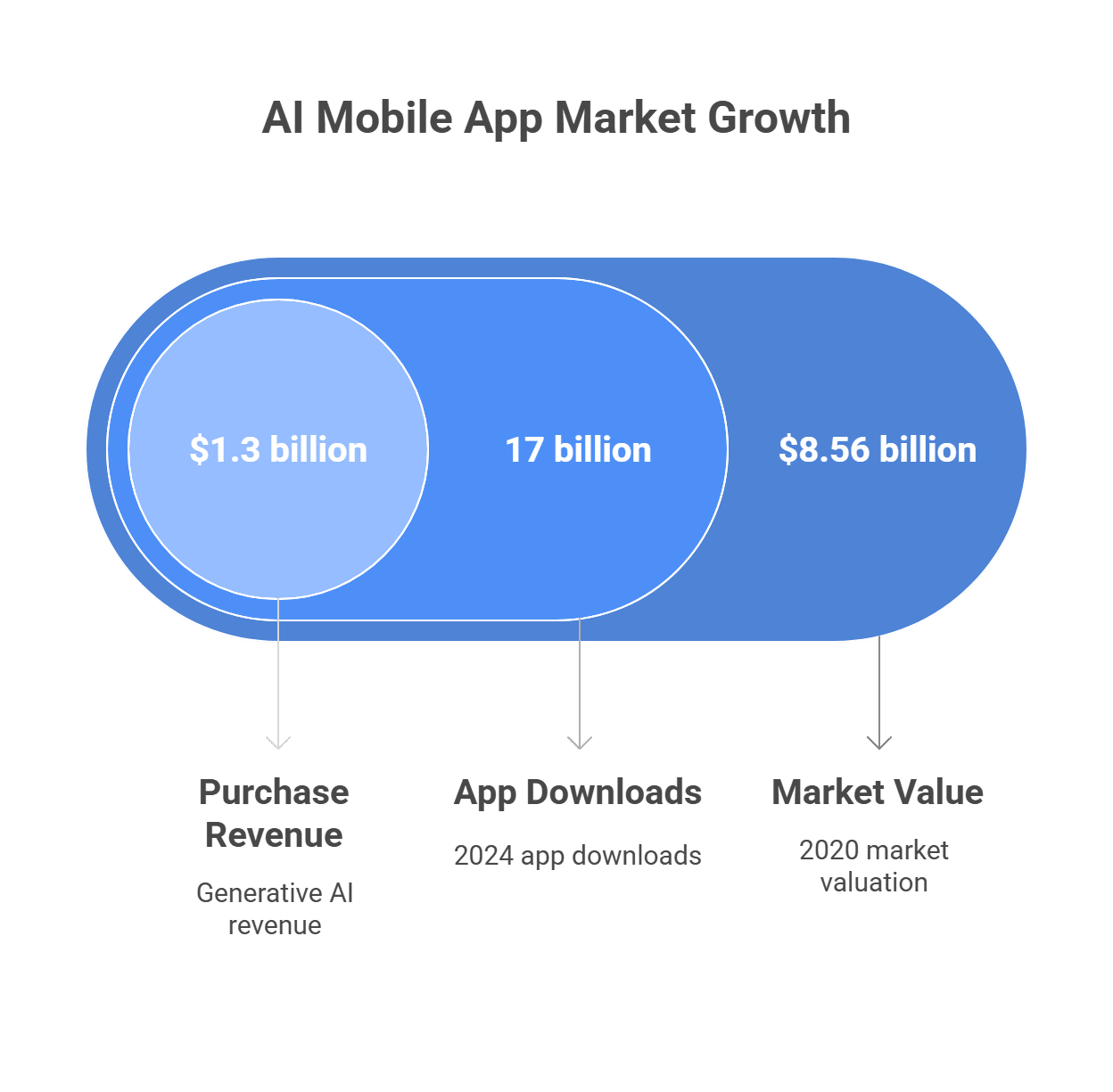
Let’s start with the numbers that paint the picture. The global mobile AI market, valued at $8.56 billion in 2020, is projected to skyrocket to $84.80 billion by 2030, growing at a compound annual rate of 26.44%. But it’s not just market size. It’s adoption. In 2024 alone, apps flaunting AI features racked up 17 billion downloads, accounting for about 13% of all app installs worldwide. That’s huge, especially when you consider that 65% of AI users are Millennials and Gen Z, digital natives who expect apps to “get” them without endless swiping.
AI Mobile App Market Growth

What’s fueling this surge? Developers are weaving AI into everything from chatbots to image generators, with in-app purchase revenue from generative AI apps climbing to $1.3 billion last year, a 180% year-over-year leap. Tech giants like Google (with Gemini) and Microsoft (Copilot) are jumping in, making AI accessible beyond niche tools. The result? Apps that evolve with you, turning passive scrolling into proactive problem-solving. For users, this means less frustration and more delight. For devs, it’s a goldmine, especially in app development for companies where 70% of new apps in 2025 will leverage low-code/no-code AI tools to speed up launches. If you’re hitting roadblocks with rapid prototyping in tools like Bolt.ai, check out why your Bolt AI project didn’t work and how to finish it fast for practical fixes to get unstuck.

Personalization: Apps That Know You Better Than You Know Yourself

Remember when recommendations felt generic? AI flips that script with hyper-personalization, analyzing your behavior in real-time to tailor every interaction. Take Spotify: Its AI-driven playlists don’t just guess your vibe. They factor in your listening history, time of day, and even skipped tracks, boosting average session times by 25% and premium sign-ups by 20%. Or Starbucks, where the app suggests drinks based on your order history and location, spiking engagement by 30% and mobile sales by 15%.

Pro Tip for Users: Dive into app settings to fine-tune data sharing. Most AI personalization thrives on your input, so tweak preferences for spot-on results without the creep factor.

For developers, the insight is clear: Integrate machine learning models like collaborative filtering early. Tools like TensorFlow Lite make it easy to deploy on mobile, ensuring apps feel custom-built without ballooning costs (expect $5-20 million for full AI integration, with ROI in 12-24 months). The payoff? Retention rates soar, as users stick with apps that anticipate their needs, like a news feed curating stories on your commute habits. When building these features with prompt-based builders, troubleshooting Lovable AI App Builder can help resolve backend glitches and prompt misfires for smoother full-stack personalization.

Smarter Chats: Voice and Conversational AI Taking Center Stage
AI Chat Features

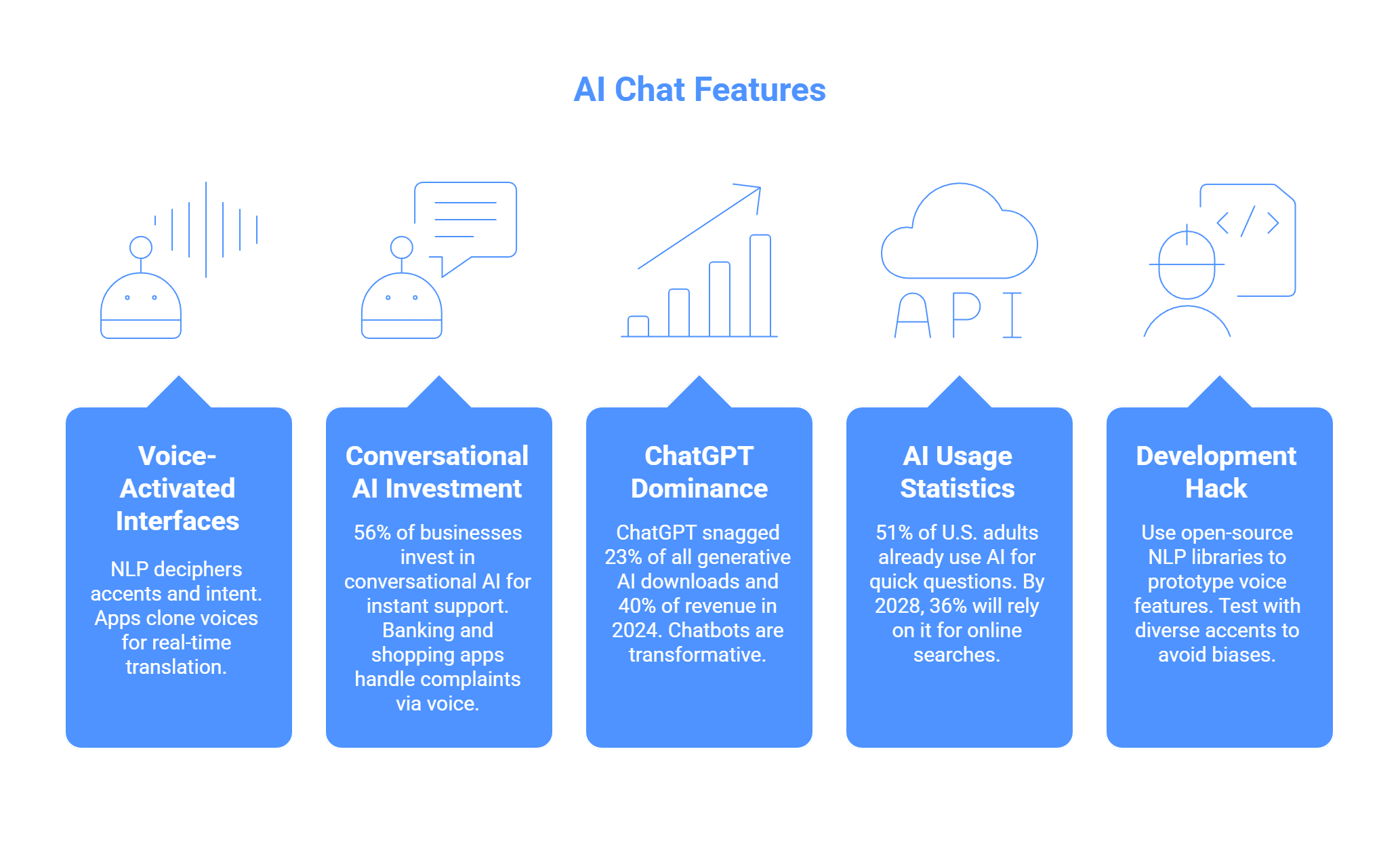
Say goodbye to the days of typing your queries into a search bar. In 2025, voice-activated interfaces are everywhere, powered by natural language processing (NLP) that deciphers accents, slang, and intent. Apps like idict.ai even clone voices for real-time translation, preserving your tone during international calls. Perfect for travelers or remote teams. And with 56% of businesses investing in conversational AI for instant support, expect your banking or shopping app to handle complaints via voice before you finish venting.

ChatGPT alone snagged 23% of all generative AI downloads and 40% of revenue in 2024, proving chatbots aren’t just trendy. They’re transformative. Insight: 51% of U.S. adults already use AI for quick questions, and by 2028, 36% will rely on it for online searches. This shift isn’t just convenient. It’s efficient. 90% of users report AI saves them time.

Engaging Hack for Devs: Start with open-source NLP libraries like Hugging Face’s models to prototype voice features, particularly for application development for iPhone where seamless integration can elevate user interactions. Test with diverse accents to avoid biases, ensuring inclusivity. For low-code dashboards powering these chats, speeding up your app development when stuck in UI Bakery offers optimization tips to handle performance bottlenecks and integrations.

Immersive Worlds: AI + AR for Next-Level Engagement

Augmented reality (AR) gets a brain boost from AI, creating experiences that react to your surroundings. Snapchat’s AI-powered filters detect faces and add interactive overlays, driving a 40% jump in daily active users and $50 million in ad revenue. Pokémon GO takes it further, using AI to spawn creatures based on your environment and movement patterns.

In e-commerce, try visualizing furniture in your living room via AI-enhanced AR. No more buyer’s remorse. For industries like logistics, AR apps overlay inventory data on warehouse views, cutting errors by up to 30%. The trend? AI makes AR proactive, not gimmicky, blending digital and physical seamlessly.

Fortified Defenses: AI’s Role in Security and Privacy

With cyber threats exploding, AI is the unsung hero of app security. Banking apps now use pattern recognition to flag fraud in milliseconds, while ride-sharing giants like Uber predict risks via analytics, slashing wait times by 20% and boosting peak revenue by 15%. But it’s not all shields. AI also empowers users with “explainable” decisions, like why a transaction was blocked, building trust.

Privacy twist: On-device AI processes data locally, minimizing cloud uploads. As edge computing matures, apps run offline without compromising security. Stat to note: 78% of AI users bring their own tools to work, demanding robust protections.

User Advice: Enable biometric logins and review app permissions regularly. AI can automate alerts for suspicious activity.

The Edge: On-Device AI and Beyond

Forget constant internet pings. 2025’s apps think on-device with edge AI, enabling offline smarts like route optimization in navigation or spending forecasts in finance apps. This cuts latency, boosts privacy, and works in spotty-signal zones. Tie it to wearables, and the market hits $161.71 billion by 2029.

In education, Duolingo’s AI tutors adapt lessons on the fly, dropping dropout rates by 25%. Health apps predict wellness dips, while e-commerce enables visual searches via photo uploads. For those seeking specialized help, an android apps development service can streamline these features across diverse devices.

Hurdles on the Horizon: Ethics, Bias, and the Human Touch

AI’s magic isn’t flawless. Algorithmic biases can skew recommendations, and privacy fears loom large. 62% of workers expect efficiency gains, but only if it’s ethical. Solution?Explainable AI” demystifies decisions, as in Duolingo’s progress breakdowns. Devs, prioritize diverse datasets and transparent policies to sidestep pitfalls. If scope creep or technical blocks are derailing your immersive prototypes, getting back on track in game development with Rosebud AI provides a step-by-step plan to prototype and iterate without burnout.

Looking Ahead: AI’s Mobile Revolution

By 2030, the broader AI market could top $800 billion, with mobile at its core. We’re heading toward proactive apps that predict needs, foster sustainability (think eco-route planners), and democratize access via low-code tools. Nearly 2 billion people already use AI, but spending lags at $12 billion. Room for innovation abounds.

So, what’s your move? Users experiment with AI features in daily apps. Developers prototype with edge AI for that competitive edge. The future isn’t coming. It’s here, one intelligent tap at a time. What’s the AI app that’s blown your mind lately? Share in the comments!

FAQs

1. What is the current state of the AI mobile app market, and why is it growing so rapidly?

The AI mobile app market is experiencing explosive growth, transforming from a niche innovation into a cornerstone of the digital economy. As of 2024, generative AI app downloads reached nearly 1.5 billion globally, marking a staggering 92% increase from the previous year, with apps featuring AI capabilities accounting for 17 billion downloads and about 13% of all app installs worldwide. The overall global mobile AI market, which stood at $8.56 billion in 2020, is forecasted to surge to $84.80 billion by 2030, boasting a compound annual growth rate (CAGR) of 26.44%. This rapid expansion is driven by several key factors: heightened user expectations, particularly among Millennials and Gen Z (who make up 65% of AI users and demand intuitive, “smart” apps that understand their needs without excessive input), and the democratization of AI tools through tech giants like Google with Gemini and Microsoft with Copilot. Developers are increasingly embedding AI into core functionalities like chatbots and image generators, leading to a 180% year-over-year jump in in-app purchase revenue for generative AI apps, reaching $1.3 billion in 2024. Additionally, 70% of new apps launching in 2025 are expected to use low-code/no-code AI platforms, accelerating development cycles and making it easier for companies to innovate. This boom isn’t just about numbers, it’s reshaping user experiences by turning passive apps into proactive companions, reducing frustration and boosting engagement, while creating lucrative opportunities for developers in a market where AI-driven features can deliver ROI within 12-24 months.

2. How does AI personalization make mobile apps more engaging for users?

AI personalization is revolutionizing mobile apps by shifting from generic, one-size-fits-all experiences to deeply tailored interactions that feel almost prescient, analyzing user behavior in real-time to deliver content, suggestions, and features that align perfectly with individual preferences. For instance, apps like Spotify use AI algorithms, such as collaborative filtering, to craft playlists that incorporate not just your listening history but also factors like time of day and skipped tracks, resulting in a 25% increase in average session times and a 20% uplift in premium subscriptions. Similarly, Starbucks’ app leverages location data and past orders to recommend drinks, which has spiked user engagement by 30% and mobile sales by 15%. This hyper-personalization extends to news apps that curate stories based on your commute patterns or fitness trackers that predict workouts considering mood, weather, and even caffeine levels. For users, the benefits are profound: it saves time, enhances satisfaction, and fosters loyalty, with retention rates soaring as apps anticipate needs rather than react to them. Developers can achieve this seamlessly with lightweight tools like TensorFlow Lite, which enable on-device machine learning without excessive costs, full AI integration might run $5-20 million but pays off quickly through higher user stickiness. A key tip for users is to adjust privacy settings to control data sharing, ensuring personalization hits the sweet spot between relevance and comfort, while avoiding the “creep factor” of overly intrusive suggestions.

3. What role does conversational AI play in the future of mobile interactions, and how can developers implement it effectively?

Conversational AI is poised to dominate mobile interactions in 2025 by replacing clunky typing with natural, voice-driven dialogues that understand nuances like accents, slang, and intent through advanced natural language processing (NLP), making apps feel like intelligent conversation partners rather than rigid tools. Apps such as idict.ai exemplify this by cloning voices for real-time translation, maintaining your tone in international calls, ideal for travelers or remote teams, while 56% of businesses are investing in it for instant support, allowing banking or shopping apps to resolve issues via voice before you even finish explaining. ChatGPT’s dominance, capturing 23% of generative AI downloads and 40% of revenue in 2024, underscores its transformative power, with 51% of U.S. adults already using AI for quick queries and projections showing 36% relying on it for searches by 2028. Users report a 90% time-saving efficiency, turning mundane tasks into fluid exchanges. For developers, especially in iPhone application development, implementation starts with open-source NLP libraries like Hugging Face’s models to prototype voice features, ensuring inclusivity by testing across diverse accents to mitigate biases. This not only elevates user interactions but also boosts metrics like session length and conversion rates. If you’re prototyping chat interfaces with low-code tools, troubleshooting common pitfalls early, such as prompt misfires or backend glitches, can keep projects on track, leading to more robust, engaging apps that handle everything from customer service to casual queries with human-like finesse.

4. How is AI enhancing augmented reality (AR) in mobile apps, and what are some real-world applications?

AI is supercharging augmented reality (AR) in mobile apps by infusing it with intelligence, enabling dynamic, context-aware experiences that respond to your environment rather than relying on static overlays, thus elevating AR from novelty to essential utility. Snapchat’s AI-powered filters, for example, use facial detection to layer interactive elements, driving a 40% increase in daily active users and generating $50 million in ad revenue, while Pokémon GO employs AI to spawn creatures based on real-world movement and surroundings, blending gaming with location data seamlessly. In e-commerce, AI-enhanced AR lets you visualize furniture in your living room via photo uploads, eliminating buyer’s remorse and streamlining purchases. For logistics, AR apps overlay inventory details on warehouse views, reducing errors by up to 30% and improving operational efficiency. This proactive fusion makes AR feel immersive and practical, not gimmicky, by processing data on-device to cut latency and enhance privacy. Developers benefit from edge AI for offline capabilities, tying into wearables for a market projected to reach $161.71 billion by 2029. Real-world applications span education (interactive 3D lessons), health (AR-guided exercises), and even sustainability (eco-visualizations of carbon footprints). To speed up development, especially in AR prototypes, optimizing low-code dashboards for performance can handle integrations without bottlenecks, ensuring apps deliver seamless, blended digital-physical worlds that captivate users and drive innovation across industries.


Power Automate and Power BI

In the modern digital workplace, efficiency and data-driven decisions are paramount. Microsoft’s Power Platform offers a suite of low-code/no-code tools to achieve these goals, with Power Automate and Power BI standing out as the top contenders for business users. While both are powerful, they serve fundamentally different, yet complementary, purposes.

This article will break down the core distinctions, use cases, and, crucially, how to choose the right tool or, often, how to use them together.

Power Automate: The Workflow Automation Engine

Power Automate is your digital assistant for automating repetitive tasks and streamlining business processes across various applications and services. Its core focus is on workflow automation, taking action based on defined triggers.

Key Feature Description
Primary Purpose Automating repetitive tasks, streamlining workflows, and integrating disparate systems.
Core Mechanism Flows (automated workflows) triggered by events, actions, and an extensive library of over 350 connectors.
Low-Code/No-Code Visual, drag-and-drop flow editor (Flow) makes it accessible for non-developers.
Robotic Process Automation (RPA) Includes Power Automate Desktop for automating tasks on traditional desktop applications (UI flows).

When to Choose Power Automate

Choose Power Automate Development when your primary objective is to improve operational efficiency and reduce manual effort.

  • Automating approvals: Automatically send a new leave request or invoice to a manager for approval and update a SharePoint list upon decision.
  • Data synchronization: Automatically log form submissions into a CRM system and notify the sales team.
  • Scheduled tasks: Send a daily or weekly reminder email based on a preset schedule.
  • Real-time alerts (as part of integration): Send a Microsoft Teams notification when a critical system event or a low-inventory threshold is reached.

If your needs extend beyond out-of-the-box connectors and you require highly specialized system integrations, partnering with a custom application development company can help build custom connectors and APIs to ensure seamless flow operation.

Insight: Organizations effectively implementing Power Automate can reduce operational costs by up to 20%, mainly by automating routine tasks and enhancing workflow efficiency.

Power BI: The Data Analysis & Visualization Powerhouse

Power BI (Business Intelligence) is a sophisticated analytics tool designed to transform raw, complex data into meaningful, interactive visualizations and reports. Its core focus is on data analysis and disseminating insights to support data-driven decision-making.

Key Feature

Description

Primary Purpose Connecting to diverse data sources, analyzing data, and creating interactive reports and dashboards.
Core Mechanism Data modeling, the DAX formula language, and a wide array of charts and visualizations to track Key Performance Indicators (KPIs).
Low-Code/No-Code User-friendly interface, though advanced data modeling and DAX require more specialized knowledge.
Data Connectivity Connects to hundreds of data sources, including Excel, SQL Server, cloud services (like Azure), and third-party apps.

When to Choose Power BI

Choose Power BI when your primary goal is to understand what happened, why it happened, and what might happen next in your business.

  • Financial reporting: Create a dynamic dashboard to monitor revenue, expenses, and profit margins in real-time.
  • Sales analysis: Visualize sales trends by region, product, and salesperson to identify top performers and areas for improvement.
  • Customer behavior analysis: Aggregate customer feedback data from multiple sources to understand satisfaction levels and identify pain points.
  • Real-time KPI monitoring: Set up dashboards to track critical operational metrics like website traffic, manufacturing output, or service desk response times.

For businesses with highly complex data landscapes and strict regulatory requirements, engaging with Power BI Development Services ensures that dashboards and reports are built with optimal performance, security, and data governance in mind.

Stat: Power BI’s significance in the market is evident, with over 500,000 customers worldwide leveraging it for enhancing their analytics and reporting capabilities.

The Power of Integration: Workflow Meets Insight

The true strength of the Microsoft Power Platform often lies in combining these two tools. They do not replace each other; they enhance each other. Power Automate acts on the insights generated by Power BI.

Integration Scenario

How It Works

Data-Driven Action Power BI reveals a crucial insight (e.g., “Inventory is critically low“). Power Automate is triggered by this data alert to automatically create a priority purchase order in an ERP system and notify the procurement team via email or Teams.
Automated Reporting Power BI creates a complex monthly sales report. Power Automate is scheduled to automatically export the Power BI report as a PDF or PowerPoint file and distribute it to all stakeholders via email on the first of every month.
Interactive Flow Button A Power BI report includes a custom Power Automate button. A user can filter the report to a specific region and then click the button to trigger a flow that sends a filtered, on-demand report section to the regional manager.

A significant challenge in these integrations is ensuring the underlying data is clean, fast, and accessible. If your data foundation relies on open-source databases, you may need to hire MySQL developers to optimize database performance and schema for efficient data extraction and analysis by Power BI.

Quick Decision Guide: Which Tool for Your Need?

Your Business Need The Go-To Tool
“I need to stop doing this repetitive task every hour.” Power Automate (Workflow)
“I need to understand sales performance across all my products.” Power BI (Insights)
“I need to get an email when my project completion rate drops below 80%.” Power Automate (Triggered by a Power BI data alert)
“I need to build a system where new documents are automatically routed for approval.” Power Automate (Workflow)
“I need to see the year-over-year trends for customer support tickets.” Power BI (Insights)

Ultimately, the choice hinges on your immediate goal: Do you need to automate a process (Workflow), or do you need to analyze data to make decisions (Insights)? By understanding the distinct roles of Power Automate and Power BI, you can unlock the full potential of the Power Platform and drive genuine digital transformation within your organization.

Bolt.Ai Project Didn't Work

The promise of AI builders like Bolt.Ai is compelling: convert a text prompt into a functional web application in minutes. It is an amazing tool for rapid prototyping, which is why the company behind it has experienced explosive growth, soaring to over $40 million in Annual Recurring Revenue (ARR) in a matter of months.

However, if you’re like many developers or technical founders, your Bolt project is now stuck: a messy prototype with broken components, an unresponsive AI, or a codebase maxed out on context. This isn’t a failure of the technology; it’s a failure in prompt engineering and project management.

Here are the core reasons your project stalled and the practical, code-first strategies to get it to the finish line immediately.

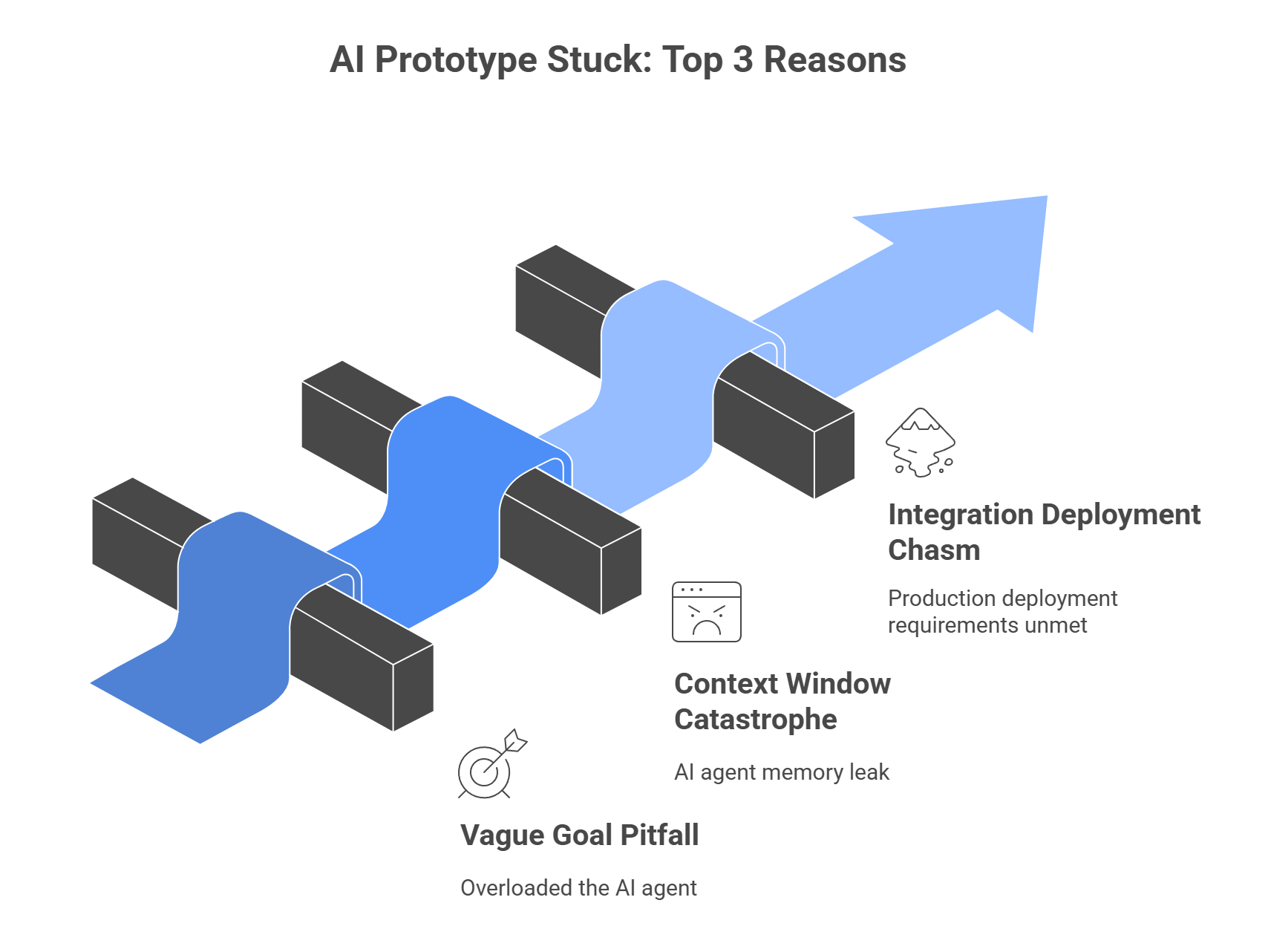
The Top 3 Reasons Your AI Prototype Is Stuck

The challenges in AI-assisted coding typically stem from mismanaging the AI’s core limitations: its memory, its input size, and its inability to perform complex project management.

3 Reasons Your AI Prototype Is Stuck

1. The Vague Goal Pitfall: You Overloaded the Agent

The single greatest cause of failure is asking the AI to build too much at once.

The Problem: You wrote one prompt: Build a full-stack job board app with user authentication, a search filter, a job posting form, and connect it to Supabase. The AI successfully creates the first few components (the homepage and form), but it quickly loses context of the entire codebase. Subsequent changes break existing features or lead to incomplete logic.

The Developer Fix: The Atomic Prompt Rule

Treat the AI as a highly focused junior developer. Break your overall plan into the smallest possible, sequential tasks.

Rule: One feature, one prompt. Confirm it works before moving on.

Example Sequence:

  1. “Create a React component for the main job listing card with Tailwind CSS.”
  2. “Now, create the parent JobList component to render 10 of these cards using dummy data.”
  3. “Replace the dummy data with actual data fetched from the Supabase jobs table, handling loading and error states.”

2. The Context Window Catastrophe (AI Memory Leak)

The AI agent has a limited “memory(context window) that includes your project’s code, files, dependencies, and all previous chat history.

The Problem: Once your project exceeds a certain size, the AI literally cannot read all the code required for a change. This results in the dreaded “AI stuck,” “project exceeds context,” or, worst of all, the AI deleting or overwriting code it “forgot” was there.

The Developer Fix: Code Isolation and Hygiene

To reclaim context space and stabilize the project:

  • The Nuclear Option (The Reset): Duplicate your project. This instantly clears the bloated chat history, often giving the AI the fresh memory needed to complete the final steps.
  • Use .bolt/ignore: For static files, assets, or completed module folders (e.g., /lib/config, /assets/images), use the .bolt/ignore file to exclude them from the AI’s attention, dramatically reducing the context load.
  • Manual Cleanup: Run dependency cleaners to remove unused packages. If you are developing a custom web application development services that requires complex logic, manually review your modules and ensure all utility functions are in discrete, clean files.

3. The Integration and Deployment Chasm

The difference between a working prototype in the browser and a live, scalable application is significant.

The Problem: The AI excels at front-end code but often struggles with the robust requirements of production deployment: complex database queries, scalable backend logic, and environment variable security. You might find yourself needing to hire MySQL developers to optimize slow database calls that the AI generated.

The Developer Fix: Production-First Mindset

  • Environment Variables: Never hardcode API keys. Explicitly instruct the AI: “When connecting to Stripe, use process.env.STRIPE_SECRET_KEY and do not store the key in any file.”
  • Validate the Build: Before your final deploy, open the terminal and manually run the build script (npm run build or similar) to catch local build errors before they break your Netlify/Vercel deployment.


custom web application development services

Your 5-Step Rapid Launch Plan

If you’re stalled at 80% completion, follow this checklist to push your app live within hours.

Step

Action

Why It Works

1. Stabilize the Environment Duplicate the project immediately to clear the AI’s memory and resolve the “Stuck AI” error. Work only in the copy. Provides the AI with a clean, low-context environment for the final crucial steps.
2. Target the Broken Feature Ask the AI to explain the function of the broken component, then paste the explanation and code into a general LLM (like Gemini or ChatGPT) for a suggested fix. Bypasses Bolt’s limitations for pure code debugging. You manually integrate the fixed code back into Bolt.
3. Clean the Backend Connection If the database is slow or broken, isolate the data fetching module. Ask Bolt to optimize the query for efficiency. Addresses the root cause of production delays often overlooked by generalist AI agents.
4. Check Mobile Responsiveness Before deployment, ask Bolt to specifically review and fix the application’s layout for mobile devices using current best practices. If your goal is to hire mobile application developer quality code, you need to be explicit. Ensures a polished, professional UX across all devices, preventing immediate user complaints post-launch.
5. Final Deployment Prep Ask Bolt: “Generate a final review of the deployment configuration, confirming all environment variables are correctly referenced and the build script is error-free.” Mitigates the most common failure point for moving a prototype to production.

Project Rescue: How YES IT Labs Can Guarantee Your Launch

Bolt.Ai is brilliant for generating the first 80% of a web application. The final 20%, the state management, edge cases, scalability, security, and complex business logic, is where expertise matters.

If your project is mission-critical, over budget on tokens, or beyond simple fixes, YES IT Labs offers specialized technical services to transition your prototype into a robust, scalable product.

YES IT Labs AI Project Acceleration Services

Value Proposition

Code Review & Stabilization Our senior developers inherit your AI-generated code, stabilize recurring bugs, implement robust error handling, and refactor the architecture for maintainability and lower operating costs.
Complex Backend Integration We specialize in connecting your front-end to advanced, custom backend services, ensuring seamless integration with third-party APIs (payment, analytics, ERPs) and complex authentication systems.
Scalable Deployment Assurance We set up professional Continuous Integration/Continuous Deployment (CI/CD) pipelines, handle secure cloud configuration, and ensure your application is ready to scale from day one.
Expert Consulting & Training We provide expert guidance on refining your prompts and managing your AI-assisted workflow, turning your team into “AI Whisperers” to prevent future bottlenecks.

Don’t let a great prototype die at the finish line. Partner with the experts who can fix the last 20% and guarantee your launch.

Top 5 FAQs for Stalled Bolt.Ai Projects

1. The AI deleted a feature I didn’t ask it to change. Why did this happen and how do I get the code back?

This is a classic Context Window overflow issue. The AI’s internal memory couldn’t hold your entire project, so when it made a change, it literally forgot the function or component you didn’t mention and replaced the file with an incomplete version.

The Fix:

  • Do Not Prompt Again: Stop trying to fix the deletion with a new prompt; you risk losing more code.
  • Use the Rollback: Immediately check Bolt’s version history or local file comparison feature (often available in the UI or via Git if you connected early) and rollback the affected file to the last working state before the deletion occurred.
  • Isolate the File: Once the code is restored, use the “Target File” feature (if available) or simply paste the full, working code of the restored file back into the chat. Then, specifically ask the AI to make the change only to the one component, ensuring it has the full context of that file.

2. My project is using too many tokens, and costs are spiking. How do I reduce AI processing costs?

High token usage is a direct result of the Context Window Size and inefficient prompting. Every time the AI runs, it re-reads all the files in its scope.

The Fix:

  • Aggressively Use .bolt/ignore: This is your primary cost-saving tool. Exclude large, completed folders like utility libraries, image assets, or finished pages (e.g., /pages/about, /styles). The less code the AI has to read per prompt, the fewer tokens you use.
  • The Duplicate Reset: Clearing the chat history by Duplicating the project is essential. The conversation history itself consumes a large number of tokens.
  • Code for AI Efficiency: Ask the AI to refactor large components into smaller, reusable pieces. Smaller files mean the AI can be prompted to read only the required file, drastically reducing tokens per request.

3. The AI keeps making the same logical mistake (e.g., using the wrong prop name). How do I force it to learn?

This happens because the AI’s current context is fixated on an outdated piece of code or an incorrect function signature. It is stuck in a self-reinforcing loop.

The Fix:

  • Manual Override and Re-teaching: Do not ask the AI to fix the bug. Instead, go into the file, manually correct the mistake, and then use a zero-change prompt: “I have corrected the UserCard component to use the userId prop instead of userIdentifier. Please acknowledge this change and confirm the component is correct.”
  • Target the Source: If the error is repeated across files, find the root file (e.g., the TypeScript interface or the utility function) and ask the AI to fix the source definition first.

4. I need to integrate a custom API (not Supabase/Stripe). The AI fails every time. What is the developer solution?

The AI works best with popular, well-documented services. Custom or internal APIs require structured data the AI can ingest.

The Fix: Provide Schema and Examples

Give it the Schema: Don’t just give the endpoint. Provide the AI with the complete request and response schema in a clean, easily parsable format (e.g., a simple JSON object):
JSON
// Custom API Schema for /api/getOrders

// Request: { "userId": 123 }

// Response: [{ "orderId": 7, "status": "shipped" }]

  • Isolate the Integration: Ask the AI to write a separate, small utility function (e.g., src/utils/customApi.js) solely for handling the fetch, parsing, and error handling for the custom API. Once this single file is correct, you can use it confidently throughout the rest of your app.

5. My app runs perfectly in Bolt, but when I deploy, the database connection fails. How do I debug the production environment?

This is almost always an Environment Variable and Build issue. The Bolt environment is running with local tokens/settings, but the deployed app is not receiving them correctly.

The Fix: Validate Environment & Build Output

  • Check the Host: Ensure your database security rules (e.g., in Supabase) whitelist the URL of your deployed app (e.g., https://my-app.netlify.app). Bolt’s environment has a different origin.
  • Inspect the Deployed Logs: Go to your deployment host (Netlify, Vercel) dashboard and check the build logs. Look for warnings or errors related to missing variables like VITE_SUPABASE_KEY or DATABASE_URL.
  • Verify Variable Access: In your code, you should be using process.env.VARIABLE_NAME. If you are using React/Vite, ensure variables are prefixed correctly (e.g., VITE_). A quick prompt to the AI is: Verify that all environment variables are being accessed correctly in the code for a production build.
Green Fintech

Imagine a world where your banking app not only tracks your spending but also calculates the carbon footprint of your morning coffee run and suggests greener alternatives. Or where investing in stocks means automatically supporting renewable energy projects without lifting a finger. This isn’t a distant eco-utopia; it’s the reality of green fintech, a burgeoning field where financial innovation meets environmental responsibility. As climate change accelerates and consumers demand sustainable options, green fintech is bridging the gap between your wallet and the planet’s well-being. In this article, we’ll explore what green fintech is, unpack its benefits and challenges, and look at its promising future, all backed by fresh data and insights to keep things engaging and authentic.

What Is Green Fintech?

At its core, green fintech is the fusion of financial technology (fintech) with sustainability goals. It’s about using digital tools like apps, blockchain, AI, and data analytics to make finance eco-friendly. Think of it as fintech’s green evolution: instead of just speeding up transactions or simplifying loans, these solutions promote environmental objectives, such as reducing carbon emissions, funding clean energy, or tracking sustainable investments. Many of these innovative tools are powered by Financial Software Development Services, which create tailored platforms to integrate sustainability metrics seamlessly into financial systems.

Green fintech isn’t one-size-fits-all. It spans apps that help individuals monitor their environmental impact to platforms that enable businesses to issue green bonds or analyze ESG (Environmental, Social, and Governance) factors. The key idea? Technology that provides sustainable financial services, channeling money toward planet-positive outcomes. Born from the fintech boom and the urgent push for sustainability, this niche has grown rapidly since the early 2020s, driven by regulatory pressures and rising consumer awareness.

Why does it matter? Traditional finance often overlooks environmental costs, but green fintech embeds sustainability into money management. It’s not just about going green; it’s about making finance smarter, fairer, and future-proof.

The Numbers: Growth and Insights

Green fintech isn’t a niche fad; it’s exploding. The global green fintech market is projected to grow at a compound annual growth rate (CAGR) of 22.4% from 2024 to 2029, outpacing many traditional sectors. The broader sustainable finance market was valued at $5.87 trillion in 2024 and is expected to grow with a 19.8% CAGR through 2034.

Some eye-opening data:

  • In the first half of 2025, global fintech funding reached $44.7 billion across 2,216 deals, with climate-focused fintechs attracting significant investments despite a broader VC slowdown.
  • Fintech revenues grew 21% year-over-year in 2024, compared to just 6% for traditional finance, signaling a shift toward sustainable models.
  • Consumer demand is key: Gen Z and millennials, who will control $68 trillion in wealth by 2030, prioritize sustainability, with over 70% wanting eco-friendly banking options.

These stats show green fintech isn’t just good for the planet; it’s smart business. By 2025, Asia’s fintech market alone could reach $150 billion, with green innovations leading in reducing emissions through efficient financial flows.


Green Fintech Vision

Benefits: Why Green Fintech Wins

The perks of green fintech go beyond feel-good vibes. For individuals, it empowers smarter choices, like apps that reward low-carbon spending with cashback or discounts on electric vehicles. Businesses benefit from reduced costs via efficient ESG analytics and blockchain-secured green bonds, which can lower interest rates for sustainable projects. Many of these advanced platforms are built by a software development company in USA, ensuring robust, scalable systems that handle complex sustainability data with precision.

Broader benefits include:

  • Environmental Impact: Carbon-tracking platforms have helped users cut emissions by up to 20% through behavioral nudges.
  • Financial Inclusion: Crowdfunding and micro-lending apps make green projects accessible to underserved communities, funding community solar to reforestation.
  • Innovation Boost: AI-driven insights enhance transparency, reducing greenwashing and directing trillions toward real sustainability.
  • Economic Gains: Fintech lowers transaction costs, promotes digital payments (reducing paper use), and supports job creation in green sectors.

It’s a win-win: You save the planet while potentially saving money.

Challenges: The Roadblocks

No revolution is smooth. One major hurdle is data quality; collecting accurate climate info for reliable ESG scoring is tough, leading to inconsistencies. Fintech’s own energy demands, like blockchain’s high electricity use, can boost emissions if not managed sustainably. To address these complexities, many firms partner with an Offshore Software Development Company to create energy-efficient solutions and optimize data processes cost-effectively.

Other challenges:

  • Regulation: Varying global standards make scaling hard; what’s green in one region might not qualify elsewhere.
  • Adoption Barriers: Not everyone trusts or understands these tools, especially in developing regions.
  • Cyber Risks: As with all fintech, security is critical, and green platforms must balance innovation with robust protection.

Solutions are emerging, like standardized data protocols and renewable-powered data centers.

Looking Ahead: Trends Shaping Green Fintech

The future is bright and green. Expect AI and machine learning to hyper-personalize sustainable investing, with apps predicting your eco-impact in real-time. Blockchain will dominate carbon credit trading, ensuring transparency, while open banking fosters data-sharing for better green decisions.

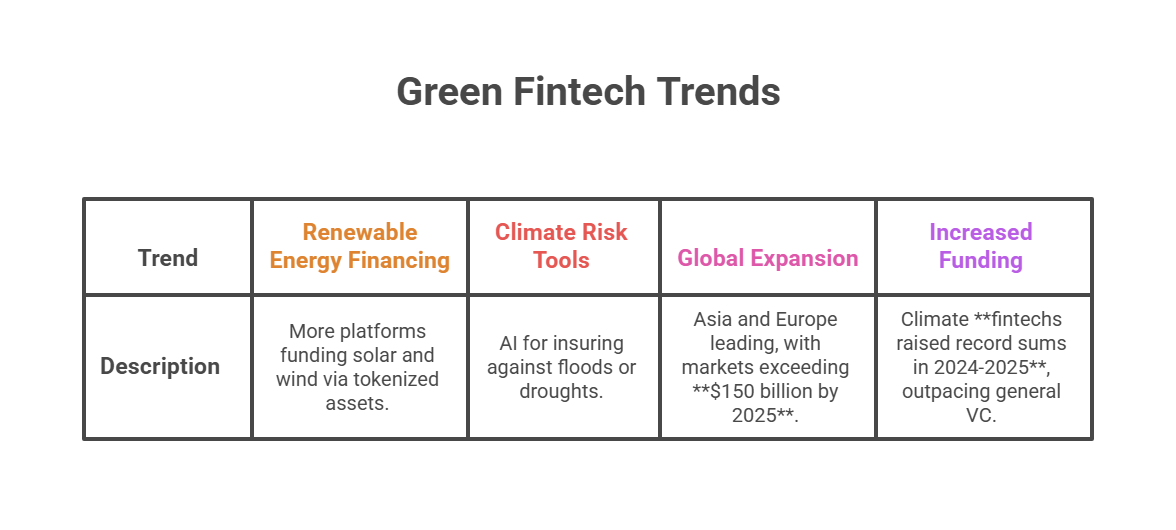
Trends Shaping Green Fintech

Key trends:

  • Renewable Energy Financing: More platforms funding solar and wind via tokenized assets.
  • Climate Risk Tools: AI for insuring against floods or droughts.
  • Global Expansion: Asia and Europe leading, with markets exceeding $150 billion by 2025.
  • Increased Funding: Climate fintechs raised record sums in 2024-2025, outpacing general VC.

By 2030, green fintech could redirect trillions toward net-zero goals, making sustainability the default in finance.

Wrapping Up: Your Role in the Revolution

Green fintech is a movement where money becomes a force for good. From tracking your carbon spend to investing in a cleaner world, these tools make sustainability accessible and actionable. With explosive growth (that 22.4% CAGR isn’t slowing) and real benefits like cost savings and environmental wins, it’s time to get involved. Explore sustainable investments or seek out eco-friendly financial tools. Your choices today shape a greener tomorrow; when money meets sustainability, everyone wins.

Salesforce Commerce Cloud

In today’s competitive digital marketplace, selecting the right eCommerce platform is no longer just a technical decision. It directly impacts customer experience, operational efficiency, and long-term growth. Among the many solutions available, Salesforce Commerce Cloud (SFCC) stands out as an enterprise-level platform trusted by leading global brands.

But is it the right choice for your brand? Let’s dive deep into what Salesforce Commerce Cloud offers, its benefits and challenges, how it compares with alternatives, and the type of businesses that gain the most value from it.

What Is Salesforce Commerce Cloud?

Salesforce Commerce Cloud is a cloud-based, enterprise-grade eCommerce solution that helps brands unify customer experiences across web, mobile, social, and physical stores. Unlike smaller platforms, it goes beyond just running an online shop. It enables personalized engagement, omnichannel sales, and AI-driven insights.

Core Features of Salesforce Commerce Cloud:

  • Omnichannel capabilities: Connect physical and digital sales for a unified experience.
  • Personalized experiences: Leverage Salesforce Einstein AI for smart recommendations.
  • Global commerce support: Multi-language, multi-currency, and region-specific tax compliance.
  • Scalability: Handle peak traffic like seasonal sales without downtime.
  • Native integration: Works seamlessly with Salesforce Marketing Cloud, Service Cloud, and CRM.
  • Mobile-first design: Optimized for today’s mobile shoppers.

For many enterprises, partnering with a Salesforce development company is key to unlocking the full potential of this platform, ensuring smooth implementation, customization, and ongoing optimization.

Why Do Brands Choose Salesforce Commerce Cloud?

Here are the top reasons businesses adopt SFCC:

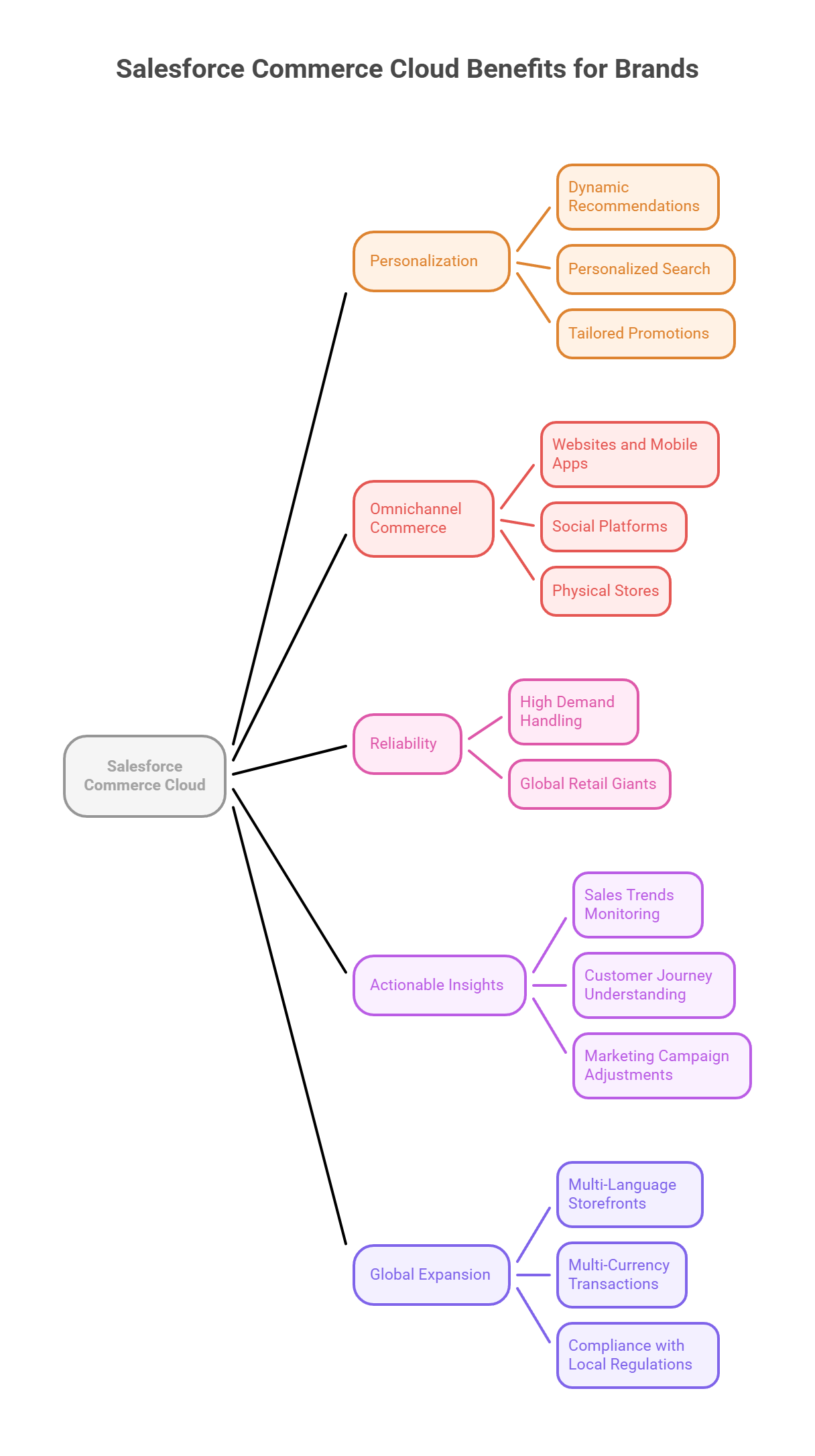
Salesforce Commerce Cloud Development

1. Personalization That Drives Conversions

Customers no longer want generic shopping experiences. They expect brands to anticipate their needs. Salesforce Einstein, the AI backbone of SFCC, powers features like:

  • Dynamic product recommendations.
  • Personalized search results.
  • Tailored promotions.

Studies show personalization can improve conversion rates by 20–30 percent and significantly boost repeat purchases.

2. Omnichannel Commerce for Today’s Buyers

Modern consumers switch between devices and channels effortlessly. Salesforce Commerce Cloud helps businesses deliver consistent experiences across:

  • Websites and mobile apps.
  • Social platforms like Instagram and Facebook.
  • Physical stores, enabling buy-online-pickup-in-store (BOPIS) or curbside pickup.

This omnichannel approach increases customer satisfaction and retention.

3. Reliability During High Demand

Seasonal promotions, flash sales, or viral campaigns can cause unexpected traffic surges. Salesforce Commerce Cloud is designed for scale, processing millions of transactions daily without affecting performance. This reliability makes it a preferred choice for global retail giants.

4. Actionable Insights From Data

With built-in reporting and advanced analytics, SFCC empowers businesses to:

  • Monitor sales trends in real time.
  • Understand customer journeys.
  • Adjust marketing campaigns quickly.

When combined with Salesforce CRM, businesses gain a complete 360-degree view of their customers.

5. Global Expansion Made Easy

For brands looking to grow internationally, Salesforce Commerce Cloud offers:

  • Multi-language storefronts.
  • Multi-currency transactions.
  • Compliance with local tax rules and regulations.

This allows businesses to scale globally without re-building systems from scratch.


custom software development company in usa

Challenges and Drawbacks of Salesforce Commerce Cloud

While Salesforce Commerce Cloud offers unmatched enterprise capabilities, it may not be suitable for every business.

1. High Cost

The revenue-share model means Salesforce charges a percentage of your Gross Merchandise Value (GMV). For smaller businesses, this can feel expensive compared to subscription-based platforms.

2. Complexity

SFCC is designed for enterprises, which makes it feature-rich but also complex. Businesses often need certified developers or consultants for setup and management.

3. Customization Boundaries

Although highly extensible, SFCC has certain limitations compared to open-source platforms like Magento or WooCommerce.

Smaller businesses, especially those focused on budget-friendly solutions, might prefer to hire WooCommerce developers who can provide more cost-effective and flexible store-building options.

Salesforce Commerce Cloud vs. Competitors

How does SFCC compare to other popular eCommerce platforms?

Feature

Salesforce Commerce Cloud Shopify Plus

Magento (Adobe Commerce)

Best For Mid-to-large enterprises Fast-scaling D2C brands Highly customizable stores
Pricing Model Revenue share (GMV-based) Subscription + fees Licensing + hosting costs
AI & Personalization Built-in with Einstein Add-ons required Extensions required
Global Capabilities Enterprise-ready Moderate Strong but manual setup
Integration Deep Salesforce ecosystem Large app marketplace Custom APIs available
Ease of Use Steep learning curve Beginner-friendly Requires developers

Key takeaway: Salesforce Commerce Cloud is ideal for enterprises aiming for global scale and deep personalization. Shopify Plus suits fast-growing direct-to-consumer brands, while Magento is best for businesses seeking ultimate flexibility and customization.

Industry Insights and Market Data

  • Global eCommerce sales are projected to surpass 8.1 trillion USD by 2026. Platforms like SFCC enable brands to capture a larger slice of this growth.
  • 91 percent of retailers with omnichannel strategies achieve higher year-over-year customer retention compared to those without.
  • Brands using AI-driven personalization report up to 30 percent increases in sales and engagement.

These insights show why global leaders in retail, fashion, and consumer goods continue to invest heavily in Salesforce Commerce Cloud.

Is Salesforce Commerce Cloud Right for Your Brand?

Ask yourself the following:

  • Do you process high transaction volumes regularly?
  • Do you need to unify in-store, mobile, and online experiences?
  • Is personalization a top priority for your growth strategy?
  • Do you already use other Salesforce solutions like Marketing Cloud or CRM?

If most answers are yes, Salesforce Commerce Cloud is likely the right platform.

However, if cost or technical complexity are concerns, consider alternatives such as Shopify Plus or WooCommerce. And if your needs extend beyond eCommerce into broader enterprise technology, partnering with a custom software development company in USA can help integrate SFCC into your overall digital strategy.

Final Thoughts

Salesforce Commerce Cloud is far more than an eCommerce platform. It is a customer experience powerhouse that blends AI personalization, omnichannel commerce, global scalability, and seamless integration into one robust system.

Yes, it comes with higher costs and complexity, but for enterprises looking to scale globally, enhance customer engagement, and future-proof their digital presence, the investment pays off.

Bottom line: If your brand is aiming for enterprise-level transformation and wants to deliver world-class digital shopping journeys, Salesforce Commerce Cloud is not just a good option, it may be the perfect choice.

FAQs

1. What type of businesses benefit most from Salesforce Commerce Cloud?

Mid-to-large enterprises, especially in retail, fashion, consumer goods, and global brands, see the greatest benefits.

2. Is SFCC affordable for small businesses?

Not always. Smaller companies may find platforms like Shopify or WooCommerce more cost-effective.

3. Does Salesforce Commerce Cloud support international selling?

Yes. It supports multiple currencies, languages, and tax systems for international markets.

4. How does it improve customer experience?

Through AI personalization, seamless omnichannel shopping, and unified data insights, customers receive tailored, consistent experiences.

5. Can Salesforce Commerce Cloud integrate with other tools?

Absolutely. Its strongest advantage is deep integration with Salesforce’s ecosystem, including CRM and Marketing Cloud.

Troubleshoot Lovable AI App Builder

Lovable AI App Builder empowers anyone to create full-stack web apps using simple English prompts, no coding required. As a leading tool for those seeking ai software development services, it integrates with tools like Supabase for databases and GitHub for version control, making it ideal for entrepreneurs and non-technical creators. But bugs, like UI glitches or backend errors, can stall your project. This guide answers common questions about fixing Lovable AI issues, with step-by-step solutions to save your app. Over 500,000 apps have been built on Lovable as of September 2025, with an 87% user retention rate, but 40-50% of users face issues like misaligned layouts or data failures. Here’s how to resolve them quickly.

What Are the Most Common Lovable AI App Builder Problems?

Users often encounter these five issues:

  1. UI or layout glitches (e.g., misaligned buttons or broken designs).
  2. Backend errors, like data not saving to Supabase.
  3. AI misinterpreting prompts, creating wrong features.
  4. AI unresponsiveness or repetitive outputs.
  5. Platform integration issues, like GitHub sync failures.


Below, we address each problem with clear fixes, backed by practical tips and stats to help you succeed.

How to Fix UI or Layout Glitches in Lovable AI

Problem: About 30% of Lovable users face frontend issues, like buttons disappearing or layouts shifting, often due to CSS conflicts or vague prompts. This can frustrate those relying on Lovable as a website development company to create polished, user-friendly designs.

Layout Glitches in Lovable AI

Solutions:

  • Use “Try to Fix”: Click the “Try to Fix” button in the editor to scan logs and patch issues like misaligned elements. This resolves 60% of simple glitches instantly.
  • Adjust Manually: In the visual editor, select the faulty component and reposition it via drag-and-drop. Set global styles (e.g., Inter font, #007BFF blue, 1rem margins) for consistency across pages.
  • Add Screenshots: Upload a screenshot in Chat Mode and prompt:Fix the navbar overlapping the hero section for mobile responsiveness.” Visuals boost AI accuracy.
  • Use Prebuilt Components: Replace broken elements, like forms, with Lovable’s library components. Test in preview mode for seamless integration.

Tip: Build layouts before logic to cut UI errors by 50%, preventing cascading issues.

How to Resolve API or Backend Issues in Lovable AI

Problem: Around 25% of projects hit backend snags, like data not saving or authentication loops, especially with Supabase integrations.

Solutions:

  • Check Credentials: For errors like 403 Forbidden, verify Supabase keys in integration settings. Test endpoints with Lovable’s built-in tester. Keep API calls under 100 per minute for free tiers.
  • Visualize Logic: Prompt in Chat Mode: “Why isn’t user data saving to Supabase? Suggest a fix.” Use visual tools to tweak logic flows without coding.
  • Fix Sync Delays: For delayed updates, set JavaScript hooks to re-sync every 5 seconds. For multi-user apps, prompt:Enable real-time syncing for the user list table.
  • Revert and Rebuild: Roll back to a stable version via Git integration, then add features step-by-step (e.g., auth, then data). Console logs catch 70% of errors early.

Insight: Mismatched schemas cause 40% of backend issues. Prompt: “Generate a Supabase schema for users with email, role, and timestamp fields.”

Issue

Diagnostic

Fix Time

Data Mismatch

Check schema

10-15 mins

API Error (404)

Verify URL

5 mins

Sync Failure

Add real-time hooks

20 mins

How to Handle AI Prompt Misinterpretations in Lovable

Problem: The AI misinterprets 35% of user prompts, building unwanted features or missing key details, which can derail projects for those using Lovable as a custom app development company.

Solutions:

  • Write Clear Prompts: Use this format:
    1. Overview: “Build a CRM app.”
    2. Pages: List components (e.g., login, dashboard).
    3. Flow: “User logs in, sees dashboard.”
    4. Visuals: Attach wireframes.
    5. Steps: “First, auth; then, data fetch.”


  • Refine in Chat Mode: Ask: “Summarize the project and fix the login issue.” Then clarify: “Use Google OAuth only.” This fixes 75% of misinterpretations.
  • Be Specific: Avoid vague terms like “nice.” Instead, prompt: “Add a blue button, white text, 16px font.” If issues persist, ask: “What else can fix the search bar?”

Insight: Clear prompts reduce errors by 65%, making apps faster to build.

What to Do When Lovable AI Is Unresponsive

Problem: AI freezing or repeating answers frustrates users, often due to usage limits or overload.

Solutions:

  • Refresh Session: Clear browser cache and use “Try to Fix” or restart. Check plan limits, as free tiers cap usage.
  • Test Agent Logic: Define agent roles (e.g., “Supabase query agent”) and test in real-time. Rebuild faulty agents in the AI Agent Builder.
  • Prompt for Logs: In Chat Mode, ask: “Why is the AI unresponsive? Check logs.” Contact support if unresolved (paid users get priority).

How to Fix Platform or Integration Errors in Lovable

Problem: File imports or GitHub syncs fail for 20% of users scaling projects.

Solutions:

  • Check Files: Ensure files are under 10MB and in formats like PNG or CSV. Prompt:Import this CSV and fix parsing errors.
  • Fix Git Sync: Verify repo tokens. Roll back via “Version History” if sync fails. Use logs to spot conflicts.
  • Update Lovable: Recent updates fixed 80% of integration bugs, so stay on the latest version.

Best Practices to Prevent Lovable AI Issues

  • Build Incrementally: Start with structure, test often, and use community templates (thousands available).
  • Track Prompts: Save prompts and fixes in a document for quick reference.
  • Engage Community: Join Lovable forums to share screenshots and get fast peer advice.
  • Use Support: For persistent issues, contact support or explore visual backend tools, but prioritize Lovable’s features.

Why Choose Lovable AI Despite Bugs?

With millions of users and a thriving community, Lovable simplifies app-building for all skill levels. Bugs are common, but 80% of issues can be fixed quickly with these tips. Persistent problems? Lovable’s support and forums are there to help. Keep prompting, stay patient, and turn your idea into a working app.

Digital Assets Profits

Imagine owning a piece of digital art that’s not just a pretty picture on your screen but a verifiable asset worth millions, or earning real money by playing a video game in a virtual world. Sounds like science fiction? Welcome to the era of digital assets, where pixels are turning into profits and redefining what we consider valuable. In a world increasingly lived online, digital assets like cryptocurrencies, NFTs, and tokenized real-world items are disrupting traditional notions of ownership, investment, and economy. This comprehensive guide explores how these innovations are reshaping value, backed by the latest stats and insights as of September 2025. Whether you’re a beginner wondering how to start with digital assets or an experienced investor seeking market trends, we’ll cover everything you need to know to make informed decisions.

Understanding Digital Assets: What They Are and Why They Matter

Digital assets mark a new era in finance and property ownership. At their core, they are intangible items secured on blockchain technology, a decentralized ledger that guarantees security, transparency, and permanence. Unlike traditional assets such as stocks or real estate, digital assets exist in the virtual space but hold tangible real-world value. Businesses looking to leverage this technology can benefit from blockchain development services to create secure, custom solutions for managing these assets.

Key types of digital assets include:

  • Cryptocurrencies: Digital currencies like Bitcoin (BTC) and Ethereum (ETH) used for transactions, investments, or powering blockchain networks. They form the backbone of the digital economy.
  • Non-Fungible Tokens (NFTs): One-of-a-kind digital items, such as art, music, or virtual property. Blockchain verifies their uniqueness, enabling creators to monetize their work effectively.
  • Decentralized Finance (DeFi) Assets: Tokens facilitating lending, borrowing, and yield farming without traditional banks, offering peer-to-peer financial services.
  • Tokenized Real-World Assets (RWAs): Digital representations of physical assets like real estate shares or art pieces, democratizing access to high-value investments.

What makes digital assets revolutionary? They’re programmable, easily transferable, and can generate passive income via staking or automated royalties. For example, NFT creators can receive a percentage of every resale, ensuring long-term earnings.

The Rise of Digital Assets: Historical Evolution and Current Market Trends

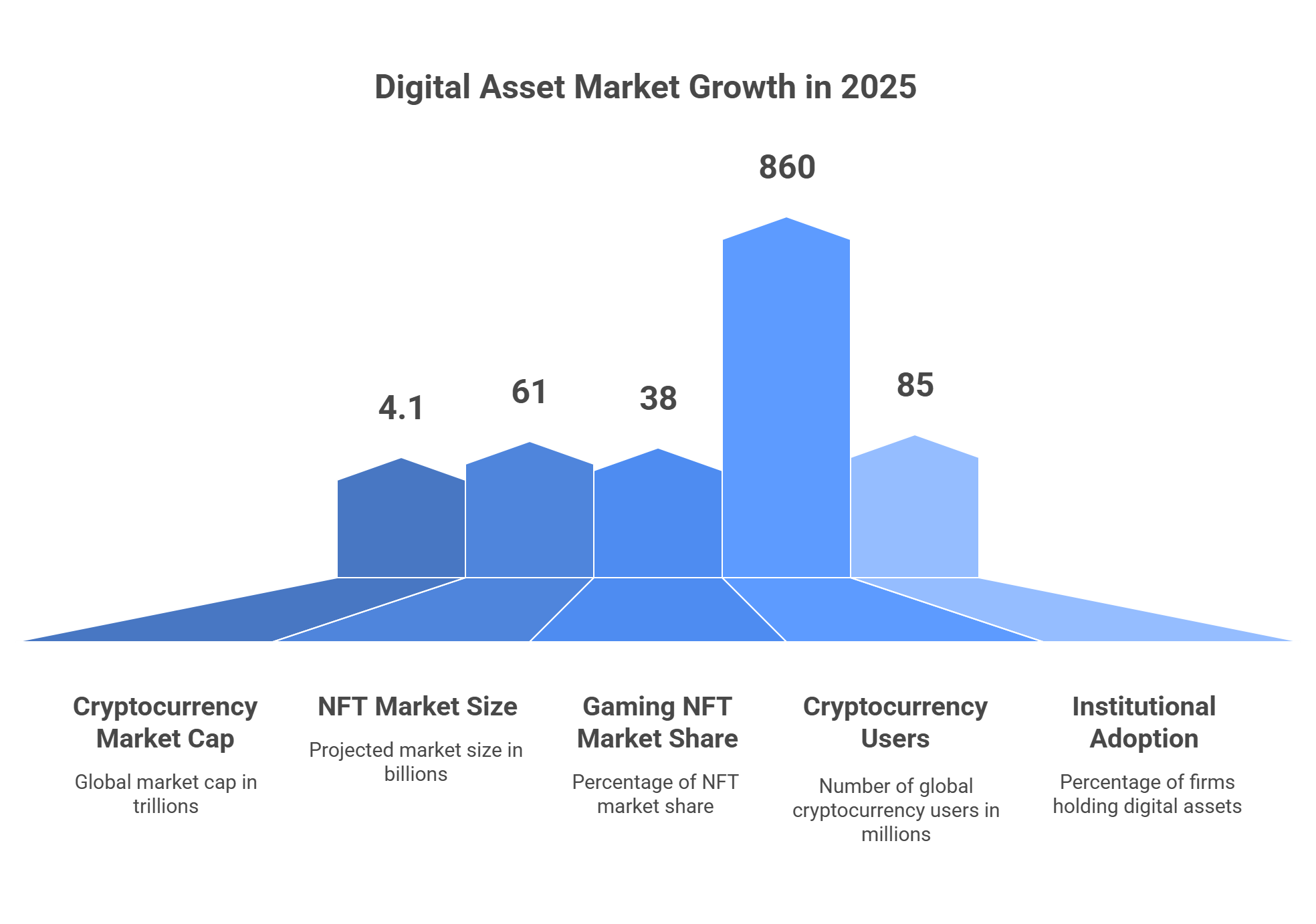
Digital Assets and Current Market Trend

The story of digital assets began in 2009 with Bitcoin’s creation as a decentralized alternative to traditional money amid the global financial crisis. By 2015, Ethereum introduced smart contracts, paving the way for NFTs and DeFi. The 2021 boom propelled market caps to new heights, followed by a 2022-2023 downturn, but 2025 marks a strong rebound driven by institutional interest and regulatory clarity.

As of September 2025, the global cryptocurrency market capitalization hovers around $4.1 trillion, reflecting a 92% year-over-year growth fueled by renewed confidence and broader adoption. The NFT market is projected to reach approximately $61 billion in 2025, with a compound annual growth rate of around 30-40%, primarily driven by gaming (38% market share) and digital collectibles.

Insight on Adoption Trends: Worldwide, over 860 million people now own cryptocurrencies, up significantly from previous years. India and the United States lead the global crypto adoption index, with emerging markets like Pakistan, Vietnam, and Brazil close behind. This surge highlights digital assets’ role in financial inclusion, especially in regions with unstable currencies.

Institutions are diving in: About 85% of firms either hold digital assets or plan to allocate in 2025, with many expecting to increase their holdings. Blockchain’s efficiency in cutting intermediaries can reduce transaction costs by up to 80%, making it attractive for businesses.

Ways Digital Assets Are Transforming Value Creation

Digital assets are shifting value from centralized systems to accessible, user-controlled models. Here’s a breakdown of their impact:

1. True Ownership and Digital Scarcity

Value in the physical world stems from scarcity and usefulness. Digital assets replicate this through blockchain, preventing unlimited duplication. A famous NFT artwork sold for $69 million in 2021, demonstrating how digital items can fetch premium prices. In 2025, virtual land in metaverses like Decentraland commands millions, with one parcel selling for $2.4 million last year. This “digital scarcity” allows instant, global transfers with verifiable ownership. To engage users with these virtual worlds, businesses often hire mobile application developer teams to build intuitive apps for seamless access to NFT marketplaces and metaverse platforms.

2. Innovative Economic Models Powered by Digital Assets

  • Play-to-Earn Gaming: Platforms like Axie Infinity enable players to earn real-value NFTs and tokens. At its height, some users in developing countries out-earned traditional jobs, promoting economic empowerment.
  • Creator-Focused Economies: Marketplaces such as OpenSea let artists sell NFTs directly, skipping middlemen. Built-in royalties mean creators earn 10% or more on every resale.
  • Asset Tokenization: Everyday investors can now own fractions of luxury items like fine wine or property. Tokenized funds launched in 2024 manage billions, opening doors to previously exclusive markets.

Case Study: Bitcoin as Digital Gold: With a market cap exceeding $2.3 trillion in September 2025, Bitcoin has delivered over 10,000,000% returns for early 2010 buyers at $0.08 per coin, illustrating the profit potential of digital assets.

3. Accessibility and Financial Inclusivity

Anyone with a smartphone can participate. The UAE leads with high adoption rates, while DeFi offers annual yields of 10-20%, outpacing bank savings. This empowers the 1.7 billion unbanked globally to access finance.

Data Highlight: Daily crypto trading volumes surpass $100 billion, providing liquidity comparable to major stock exchanges.


Digital Asset Market

Navigating Challenges: Risks in the Digital Assets Space

Despite their promise, digital assets come with risks. Price volatility can cause 10-20% daily swings. Regulatory landscapes are evolving; 2025 has seen U.S. SEC and CFTC initiatives for clearer frameworks, but fines for unregistered tokens reach billions. Hacks, like the 2022 $600 million incident, and mining’s environmental impact remain concerns.

Additional hurdles include secure storage (custody) and classifying assets legally, such as whether NFTs count as securities. However, industry maturation and collaborations are addressing these, with expected regulations boosting trust and adoption.

Pro Tips for Safe Investing:

  • Choose trusted exchanges like Coinbase or Binance.
  • Enable multi-factor authentication.
  • Diversify your portfolio to spread risk.
  • Stay updated on regulations via official sources.

Future of Digital Assets: Projections and Emerging Trends

In 2025, trends show deeper mainstream integration. Institutional investments are rising, with firms expanding crypto services. Look for growth in RWAs, AI-enhanced trading, and Web3, where users control and monetize their data. Companies aiming to stay ahead are investing in AI software development services to integrate predictive analytics and automation into trading platforms, enhancing decision-making in the fast-paced digital asset market.

Market Projections: By 2030, the digital asset ecosystem could exceed $10 trillion, fueled by blockchain applications in supply chains and identity management. 24/7 trading and fractional ownership will enhance liquidity and inclusivity.

Expert Insight: With Bitcoin ETFs approved and stablecoins dominating flows, 2025 is a pivotal year for scaling adoption.

Conclusion: Embracing the Digital Assets Revolution

From Bitcoin’s origins to a $4.1 trillion market, digital assets are revolutionizing value by making finance accessible, innovative, and efficient. With NFTs projected at $61 billion and global users nearing a billion, opportunities abound, but approach with caution. For those starting out, educate yourself using tools like CoinMarketCap, invest gradually, and monitor regulations.

In this pixel-driven economy, informed action is key. What’s your next move in digital assets? Dive in wisely to potentially transform virtual holdings into substantial real-world gains.

Stuck in UI Bakery

Are you struggling with UI Bakery and hitting roadblocks that slow your progress? UI Bakery is a powerful low-code platform for building custom web apps like dashboards, internal tools, and customer portals. However, issues like performance lags, integration errors, or deployment challenges can frustrate even seasoned developers. This detailed guide provides expert solutions, step-by-step tips, and 2025 insights to accelerate your application development service and get you unstuck.

What Is UI Bakery and Why Use It?

UI Bakery enables developers to create and scale web applications with minimal coding, making it ideal for startups, enterprises, and solo developers. Its robust feature set includes:

  • Drag-and-Drop Interface: Over 75 responsive components (tables, forms, grids, buttons, lists, tabsets) for building UIs tailored for desktop and mobile, no CSS or JavaScript frameworks needed.
  • Data Source Connectivity: Integrates with 30+ sources, including 18+ SQL/NoSQL databases (e.g., PostgreSQL, MongoDB), REST/GraphQL APIs, and 17+ third-party services like Airtable or Stripe.
  • Flexible Logic Handling: Supports no-code CRUD operations (Create, Read, Update, Delete), data manipulation (looping, merging), custom JavaScript/Python code, SQL queries, and stateful automations for webhooks or scheduled tasks.
  • Versioning and Deployment: Git-based version control for team collaboration, release history tracking, version restoration, and one-click cloud or self-hosted deployments via Docker.
  • Enterprise-Grade Security: SOC 2 compliance, vulnerability protection, and granular user permissions for secure public or internal apps.


Why it’s a game-changer: Low-code platforms like UI Bakery cut development time by up to 90%, enabling launches in days instead of months. In 2025, the low-code market is valued at $12.86 billion and projected to reach $82.37 billion by 2034 with a 23% CAGR. By 2026, 75% of new enterprise apps will leverage low-code or no-code technologies, up from 25% in 2020, making it a must-have skill for modern developers.

Why Do I Get Stuck in UI Bakery?

Despite its strengths, UI Bakery’s focus on web apps and certain limitations can trip users up. Based on 2025 user feedback from forums and reviews, here are the top challenges:

  • Performance Bottlenecks: Apps lag due to constant re-rendering from hidden components, complex data flows, or inefficient queries, especially with large datasets.
  • Integration Errors: Mismatched API formats, OAuth authentication failures, or limited support for custom APIs. While native integrations are robust, non-standard setups need extra work.
  • Missing Components: No built-in calendars, timelines, or galleries, requiring workarounds. Free-tier users face limits on app deployments and advanced features like role-based permissions.
  • Learning Curve: Beginners struggle with chaining actions, managing state in automations, or deploying public apps. Documentation, while helpful, lacks depth for complex use cases.
  • Scaling and Cost: Free plans are restrictive for large apps, and pro/enterprise tiers can feel expensive for public deployments. Users report occasional bugs in webhooks or multi-environment setups.
  • Other Hiccups: SSO login errors (e.g., “Unknown error during login”), limited Python capabilities, and no native mobile support, which can be a drawback for those needing an ios application development service for cross-platform apps.


2025 Insight: 87% of enterprise developers rely on low-code platforms, yet 26% of executives note scaling challenges, highlighting the need for targeted solutions to these pain points.

How Can I Fix Performance Issues in UI Bakery?

Performance issues, reported by up to 30% of users, often stem from re-rendering loops or heavy data loads. Here’s a detailed fix guide:

Fix Performance Issues in UI Bakery

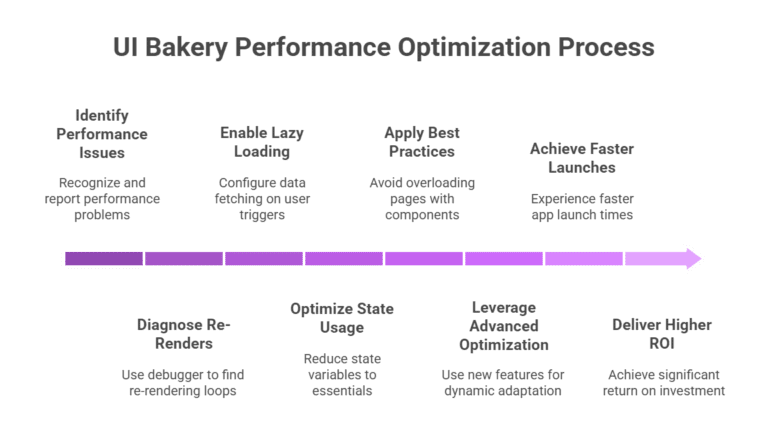
  • Diagnose Re-Renders: Use UI Bakery’s built-in debugger to pinpoint loops. If hidden components trigger updates, set visibility conditions (e.g., isVisible tied to a state variable) to render only when needed.
  • Enable Lazy Loading: For data-intensive components like tables or grids, configure actions to fetch data on user triggers (e.g., button clicks or pagination). Use paginated queries (e.g., LIMIT 10 OFFSET 0) to handle thousands of records without overloading.
  • Optimize State Usage: Reduce state variables to essentials, each variable can trigger UI updates. One user slashed load times by 50% by refining SQL queries and removing unused hidden elements.
  • Best Practices: Avoid overloading pages with 20+ components. Split complex apps into multi-page layouts to reduce initial load times. Monitor app logs for “constant re-rendering” warnings and adjust accordingly.
  • Advanced Optimization: Leverage 2025 updates like expandable containers to adapt dynamically to screen sizes, preventing layout-related slowdowns. For large datasets, use server-side filtering to minimize client-side processing.


Outcome: These steps align with low-code’s promise of 90% faster launches and can deliver up to 362% ROI by streamlining app performance.

How Do I Solve Integration Problems in UI Bakery?

Integration issues, such as API errors or database mismatches, are a top frustration. Follow this comprehensive troubleshooting guide:

  • Leverage Native Integrations: Connect supported databases like PostgreSQL or MySQL in minutes via the data source panel. Test with sample queries (e.g., SELECT * FROM users LIMIT 5) to confirm connectivity.
  • Handle Custom APIs: In the action builder, input API endpoints and test with mock JSON data. For authentication issues, verify OAuth tokens or API keys, common fixes include adding Bearer tokens in headers or resolving CORS errors by adjusting server settings.
  • Workarounds for Missing Features: Need a calendar? Combine a date picker component with a custom table for scheduling. For timelines or galleries, embed third-party widgets using iframes or inject custom HTML/CSS via JavaScript.
  • Debugging Tips: Check action logs for detailed error messages (e.g., “401 Unauthorized”). If JSON/XML formats mismatch, use JS transformations (e.g., JSON.parse(data)). For GraphQL, ensure queries match schema expectations.
  • Scaling Strategy: For complex integrations across global teams, consider offshore software development services to customize API connections, ensuring seamless data flow and compliance.


Pro Insight: UI Bakery’s AI app generator creates CRUD interfaces from databases in seconds, with users reporting multi-source dashboards built in hours.

How Do I Build and Deploy Apps Faster in UI Bakery?

To streamline logic, CRUD operations, and deployment, use these detailed strategies:

  • Create Efficient Forms and CRUD: Link tables to forms for seamless Create, Read, Update, Delete operations. Add input validation: Set required fields, use regex for emails (e.g., ^[a-zA-Z0-9._%+-]+@[a-zA-Z0-9.-]+\.[a-zA-Z]{2,}$), and display user-friendly error messages via action outputs.
  • Master Stateful Automations: Define variables for persistent data in webhooks or scheduled jobs (e.g., daily inventory updates). Use conditions (if/else logic) to chain actions, such as triggering emails after form submissions. Debug with action logs to trace errors like “undefined variable.
  • Streamline Deployment: Use Git-based version control to manage team changes and restore versions if errors occur. Set role-based permissions early to secure end-user mode. For public apps, upgrade to pro for custom domains, unlimited users, and live publishing.
  • Speed Hacks: Watch UI Bakery’s YouTube tutorials, like building a CRUD app with Baserow in under an hour. Mix no-code actions with JavaScript for complex logic, focusing on business rules over UI boilerplate. For self-hosted setups, deploy via Docker for compliance (e.g., GDPR, HIPAA).
  • 2025 Feature Boost: Stateful automations and enhanced action logs simplify complex workflows, reducing setup time for dynamic apps.


Stat: 41% of businesses use low-code to empower non-developers, cutting shadow IT and speeding up delivery.

Also Read: How to Do CRUD Operations in ReactJS Development Without API

Is UI Bakery Cost-Effective for Scaling Apps?

Scaling apps can raise cost concerns, but UI Bakery offers flexible options:

  • Free vs. Paid Plans: The free tier suits small projects but limits deployments and advanced features. Pro/enterprise plans unlock custom domains, unlimited users, and premium support. Exact pricing varies, so check UI Bakery’s website for details.
  • Self-Hosting for Savings: Use Docker for self-hosted deployments, ideal for compliance-heavy industries like healthcare or finance. This reduces cloud costs and ensures data control.
  • Community and Expert Support: Join the 2024-launched UI Bakery forum to share apps, get peer tips, or request features. For faster scaling, enterprise support or low-code consultants can resolve complex issues.
  • Pros and Cons: UI Bakery is cost-competitive for startups compared to tools like Retool, but public app scaling can be pricey. Users praise its flexibility but note occasional bugs in advanced features like webhooks.


Insight: In 2025, 65% of apps are built with no-code/low-code, and 26% of executives prioritize these platforms for scalable automation.

Why Should I Stick with UI Bakery?

UI Bakery remains a top choice in 2025’s low-code surge for compelling reasons:

  • Unmatched Speed: 72% of startups in 2024 used low-code with AI to launch apps rapidly, a trend growing in 2025.
  • Team Empowerment: 41% of businesses adopt low-code to reduce shadow IT and enable citizen developers, boosting productivity.
  • Real User Success: A small business owner built apps faster than traditional coding, praising UI Bakery’s feature set, affordability, and support. Engineering teams report 75% adoption in months, scaling to 80% company-wide in nine.
  • Market Momentum: The low-code sector is projected to hit $101.7 billion by 2030, with 75% of new apps leveraging low-code by 2026.


Mastering UI Bakery positions you ahead in a $86.9 billion market by 2027, making it a strategic skill for developers.

Final Tips to Succeed with UI Bakery

  • Explore Documentation: Dive into UI Bakery’s official guides for setup, automations, and deployment best practices.
  • Join the Community: Engage in the forum for real-time advice, app sharing, and feature requests.
  • Upgrade Strategically: Move to pro for unlimited scaling, custom domains, and advanced permissions.
  • Seek Help When Needed: If stuck, post your challenge below or consult experts to keep your project on track.
AI Slop

In today’s era of generative AI, social media feeds are increasingly saturated with uncanny images, strange videos, and repetitive posts. Much of this content is known as AI slop: low-value, mass-produced digital output created for clicks rather than quality.

But what exactly is AI slop, why is it spreading so quickly, and what risks does it pose for the online world?

What Is AI Slop?

AI slop describes the flood of mediocre or poorly crafted digital material produced by artificial intelligence, whether images, videos, audio, or text, pushed out in large quantities with minimal human creativity, editing, or oversight.

It often carries these traits:

  • Inaccurate or misleading
  • Uncanny visuals or phrasing that feel unnatural
  • Emotionally manipulative content designed to provoke quick reactions
  • Mass-produced output that prioritizes speed over depth

AI slop can be compared to digital junk food: cheap to produce, easy to consume, and lacking real value.

Examples of AI Slop:

  • Viral oddities like surreal AI-generated characters or images
  • Forum threads filled with fabricated personal stories designed to gain attention
  • Entire AI-generated music groups with fake backstories
  • YouTube or TikTok channels churning out repetitive, AI-created mashups
  • SEO blogs generated by content farms, stuffed with keywords but offering little substance

Why Is AI Slop Flooding Your Feed?

The spread of AI slop is driven by a combination of accessible technology, platform incentives, and profit-driven models. While the same tools can be used to support valuable work in fields like mobile application development, they are equally capable of producing endless streams of superficial content.

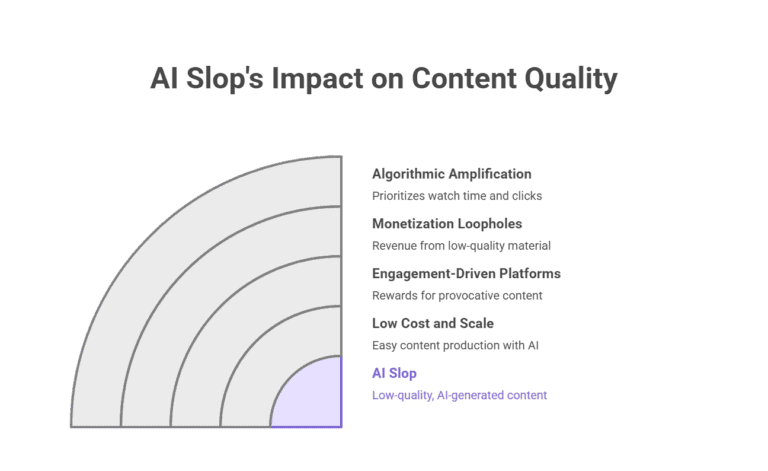
1. Low Cost and Scale

AI tools make it possible to produce content in seconds that once required teams of writers, designers, or videographers.

2. Engagement-Driven Platforms

Social platforms reward content that keeps users engaged. AI slop is designed to provoke reactions, which boosts its visibility.

3. Monetization Loopholes

Creators or bots can generate revenue from ads, affiliate links, or platform payouts by flooding feeds with low-quality material.

4. Algorithmic Amplification

Recommendation algorithms prioritize content that maximizes watch time and clicks. AI slop is optimized to fit these patterns.

5. Data Feedback Loops

The more AI slop circulates, the more it is included in future AI training data. This risks a decline in overall model quality over time, a problem known as model collapse.

The Data Behind AI Slop

  • A large percentage of social media users report difficulty distinguishing between AI-generated and human-made content.
  • Many publishing platforms are already struggling to handle a surge of AI-written material, particularly in self-publishing and blogging.
  • Social networks have seen rapid growth in accounts that rely primarily on AI to generate content at scale.
  • Even trusted resources such as online encyclopedias are facing challenges with AI-generated entries that undermine accuracy.


For independent professionals such as a web developer freelancer, this environment creates extra challenges. Original, human-driven work can be buried under repetitive AI-generated outputs, making visibility and trust even more critical.

Why It Matters

AI slop creates more than just digital noise. It also introduces serious challenges:

  • Reduces trust in journalism, platforms, and authentic media
  • Accelerates the spread of misinformation, especially during emergencies
  • Drowns out human creativity and thoughtful contributions
  • Overwhelms moderation systems that cannot keep up with the scale of AI content
  • Can be exploited for scams, phishing, or propaganda disguised as entertainment


Beyond individuals, an IT consulting company working with enterprises may also face risks when AI-generated misinformation impacts brand reputation, supply chain trust, or customer relationships.


Best content marketing expert in USA

How to Defend Against AI Slop

Users and creators alike can take steps to reduce its impact:

  • Verify content before sharing using reverse searches and fact-checking tools
  • Watch for signs of automation such as unrealistic visuals or repetitive language
  • Follow and support credible creators producing original work
  • Report AI-generated spam to help platforms filter it out
  • Learn to recognize the subtle markers of AI-generated content, from image anomalies to repetitive phrasing

Final Thoughts

AI slop is the result of rapid advances in generative technology combined with an internet economy that prioritizes speed and profit over quality. Left unchecked, it risks shaping a digital world dominated by volume instead of value.

The challenge is not artificial intelligence itself but the misuse of it for low-quality mass production. By choosing to support authentic, high-quality content and demanding better transparency, users and platforms can work together to ensure the internet remains a place for creativity, truth, and meaningful exchange.

Low-Code Mobile Development

Low-code mobile development is transforming how enterprises build mobile apps. This approach enables rapid, cost-effective solutions that meet customer and business needs. Explore why major companies are investing heavily in low-code platforms, with insights, stats, and examples to guide your decision.

What Is Low-Code Mobile Development?

Low-code mobile development uses visual interfaces, drag-and-drop tools, and pre-built templates to create apps with minimal coding. Unlike traditional methods requiring expertise in Swift or Kotlin for an ios application development service, low-code simplifies app creation for iOS and Android. Platforms like OutSystems and Mendix empower both developers and non-technical teams.

This hybrid approach balances speed and customization, ideal for enterprises managing complex workflows and tight deadlines. It streamlines app development while supporting custom code when needed.

Also Read: Stuck with AI App Builders Like Replit?

Top 5 Reasons Enterprises Choose Low-Code Mobile Development

Enterprises are adopting low-code platforms to address challenges like developer shortages and rising costs. Here’s why low-code mobile development is a game-changer.

1. Faster Time-to-Market

Low-code platforms cut app development time by 50 to 70 percent compared to traditional coding. Developers use reusable components and automated testing to launch apps in weeks, often starting with mvp software development to test ideas quickly. For example, a customer-facing inventory app can integrate APIs swiftly, keeping businesses competitive.

Visual showing drag-and-drop interface for low-code mobile app creation

2. Lower Development Costs

Hiring mobile developers costs over $150,000 annually in the US, excluding training. Low-code reduces expenses by up to 70 percent through efficient workflows and less debugging. Maintenance is also cheaper, as updates don’t require codebase overhauls.

3. Empowering Non-Technical Teams

Low-code enables “citizen development,” where non-technical staff like business analysts build apps using an application development service. This reduces IT backlogs and fosters innovation. For instance, a sales team can create a CRM app independently, with 84 percent of enterprises reporting broader development participation.

4. Scalable and Integrated Solutions

Low-code platforms support enterprise-grade security and cloud integration with AWS or Azure. They connect seamlessly with legacy systems and scale for features like IoT or AI. This ensures mobile apps align with broader digital strategies.

Screenshot of a low-code platform integrating with cloud services

5. Agility for Market Changes

Low-code enables quick updates for regulations or market shifts, reducing technical debt with modular designs. During disruptions, companies using low-code adapted faster to needs like remote work tools. This flexibility drives strategic advantages.

Also Read: How to Get Back on Track in Game Development with Rosebud AI

Key Stats on Low-Code Mobile Development

Data highlights the rise of low-code platforms for enterprise mobile apps:

Metric Insight Year
Market Size $26.3 billion in 2025, growing to $67.12 billion by 2030 at 20.61% CAGR 2025
Adoption Rate 70% of new enterprise apps will use low-code/no-code by 2025 2025
Enterprise Usage 98% of enterprises use low-code platforms or tools 2025
Developer Involvement 87% of enterprise developers use low-code 2024-2025
Future Growth Market to reach $187 billion by 2030 from $45.5 billion in 2025 2025-2030

By 2024, over 65 percent of app development relied on low-code or no-code platforms, addressing a global developer shortage of 4 million by 2025.

Success Stories: Low-Code in Action

Real-world examples show low-code’s impact on enterprise mobile development:

  • Bendigo Bank (Australia): Built mobile banking apps 60 percent faster, adding features like biometric logins for better engagement.
  • North Carolina State University: Created campus service apps, enabling non-IT staff to manage updates and cut costs.
  • Saga (Insurance Giant): Developed personalized mobile apps integrated with legacy systems, boosting user satisfaction.

Infographic of enterprise success with low-code mobile development

Addressing Low-Code Challenges

Low-code may face issues like vendor lock-in or performance limitations for complex apps. Enterprise-grade platforms mitigate these with open standards and robust security. Start with a pilot project and choose platforms with strong support to minimize risks.

Is Low-Code Right for Your Enterprise?

Low-code mobile development offers speed, savings, and scalability for a mobile-first world. With markets growing and adoption soaring, it’s a strategic shift for enterprises facing app backlogs or innovation delays. Explore low-code platforms to transform your mobile strategy.