Resources

AI Powered Mobile Apps development

Artificial intelligence has transformed the way modern mobile apps are built and experienced. From real time recommendations to computer vision and conversational tools, AI driven features are now the backbone of innovative digital products. With AI adoption increasing by nearly 270 percent since 2019 according to Gartner, businesses are rapidly searching for frameworks that support speed, flexibility, and scalable integrations.

React Native has quickly become a top choice in this space. Statista reports that around 42 percent of mobile developers prefer React Native, making it one of the leading cross platform development frameworks available today. Its performance, adaptability, and rich ecosystem make it especially suitable for building intelligent applications.

Here is a complete, insightful breakdown of why React Native stands out for AI powered app development.

1. Faster and More Efficient Cross Platform Development

AI features require extensive experimentation, testing, and refinement. React Native supports a single codebase for both iOS and Android, allowing faster delivery of app features and reducing the overall development workload.

Benefits for AI projects:

  • Launch apps on multiple platforms quickly
  • Maintain consistency in AI behavior across devices0
  • Reduce development cost by 35 to 50 percent
  • Speed up testing and deployment cycles

Many businesses rely on a mobile application development workflow to accelerate the launch of advanced AI features, and React Native aligns perfectly with this requirement.

2. Simple Integration With Advanced AI and Machine Learning Libraries

React Native smoothly integrates with powerful machine learning technologies. Developers can easily connect cloud APIs, import ML models, or use on device intelligence.

Popular AI integrations include:

  • TensorFlow Lite for image recognition, object detection, and gesture tracking
  • PyTorch Mobile for deep learning inference
  • OpenAI GPT based APIs for conversational apps and smart content generation
  • Google ML Kit for face detection, barcode scanning, and text recognition

This level of integration is especially valuable for any growing react native app development company that wants to deliver next generation AI features efficiently.

3. Strong Support for On Device AI Processing

On-device AI is becoming essential because of its speed, privacy benefits, and offline capability. Deloitte reports that running AI models locally can reduce latency by 30 to 60 percent when compared to cloud processing alone.

React Native allows developers to integrate on-device inference with tools like TensorFlow Lite and ML Kit. This is useful for apps involving:

  • Live camera analytics
  • Personal health monitoring
  • Real time object tracking
  • Security and fraud detection

It improves performance and enhances user privacy at the same time.

4. Large Community and a Powerful Ecosystem

React Native has one of the most active communities in the global developer ecosystem. This ensures quicker problem solving, regular framework updates, and continuous improvement in AI friendly tools. Developers benefit from open source packages, pre built modules, and strong documentation.

Large companies such as Tesla, Meta, Shopify, and Discord already use React Native, which reinforces its stability for long term AI focused projects.

5. Faster Experimentation With Hot Reloading

AI projects rely on constant testing and rapid iteration. React Native’s Hot Reloading feature allows developers to instantly view UI or logic changes without rebuilding the whole application. This accelerates the refinement of AI outputs, parameter tuning, and overall user experience testing.

This capability is especially helpful when businesses hire react native app developers who need a productive working environment for rapid prototyping.

6. Cost Effective Development and Maintenance

AI development services involves significant costs in model training, data processing, and backend infrastructure. React Native helps minimize expenses by reducing the need for separate iOS and Android teams. Companies can focus their budgets on expanding AI capabilities instead of building two separate apps.

This approach is highly beneficial for organizations looking to scale quickly without sacrificing quality.

7. High Performance for AI Features When Optimized Correctly

React Native offers near native performance when configured properly. Developers can use native modules written in Java, Swift, or C++ and run AI inference outside the JavaScript thread. This ensures a smooth user experience even when handling computation heavy AI tasks.

GPU acceleration and React Native’s new architecture further help in handling complex machine learning models.

8. Easy Integration With Cloud Based AI Platforms

Many AI powered apps rely on cloud ecosystems for model training, analytics, and advanced processing. React Native works smoothly with:

  • AWS AI and ML services
  • Google Cloud Vertex AI
  • Microsoft Azure Cognitive Services
  • Firebase ML tools
  • OpenAI and Hugging Face APIs

This offers flexibility to run AI models on device, in the cloud, or through a hybrid system depending on business needs.

9. Rapid Deployment of AI Improvements

The AI landscape evolves quickly, with new models and optimizations released frequently. React Native allows developers to push instant updates using tools like Microsoft CodePush and Expo Updates. This makes it easy to release:

  • Bug fixes
  • AI accuracy improvements
  • New AI features
  • Performance enhancements

The ability to deliver updates without app store delays gives AI powered apps a strategic advantage.

Practical Use Cases of AI Powered React Native Apps

1. Conversational Apps and Smart Assistants

Useful for customer support, productivity tools, therapy assistants, and chat applications.

2. Health and Wellness Platforms

Includes pose tracking, heart rate monitoring, symptom detection, and predictive health insights.

3. E Commerce and Retail

AI helps with product discovery, recommendation engines, fraud detection, and virtual try on features.

4. Financial and Banking Apps

Used for risk scoring, spend analysis, biometric verification, and sentiment analysis.

5. Media and Content Apps

Includes automated captioning, personalized suggestions, and AI enhanced video or audio processing.

These use cases highlight how React Native can support a broad range of intelligent features efficiently.

Final Thoughts

React Native offers businesses a strong foundation for building AI powered mobile apps. It supports rapid development, scalable integrations, on device intelligence, and cost effective engineering. With the global mobile AI market expected to reach nearly 84 billion dollars by 2030 according to Allied Market Research, choosing the right technology framework is essential for long term success.

React Native provides that advantage with its flexibility, performance, and thriving community.
Cloud App Development

If you’ve used Google Docs, collaborated on Slack, or binged a show on Netflix, you’ve used a cloud application. These apps live on the internet, not on your computer, allowing you to access them from anywhere. Whether you’re on a desktop or using an app from a provider of android app development services, you’re connecting to the cloud. But behind this convenience is a revolutionary shift in how software is built, deployed, and scaled.

Cloud app development is the process of building applications that run in a cloud computing environment, rather than on a local server or a user’s personal device.

This article breaks down the foundational layers of the cloud, the critical difference between “cloud-based” and “cloud-native,” and why this approach has become a game-changer for businesses of all sizes.

The Foundations: Cloud Service Models (IaaS, PaaS, SaaS)

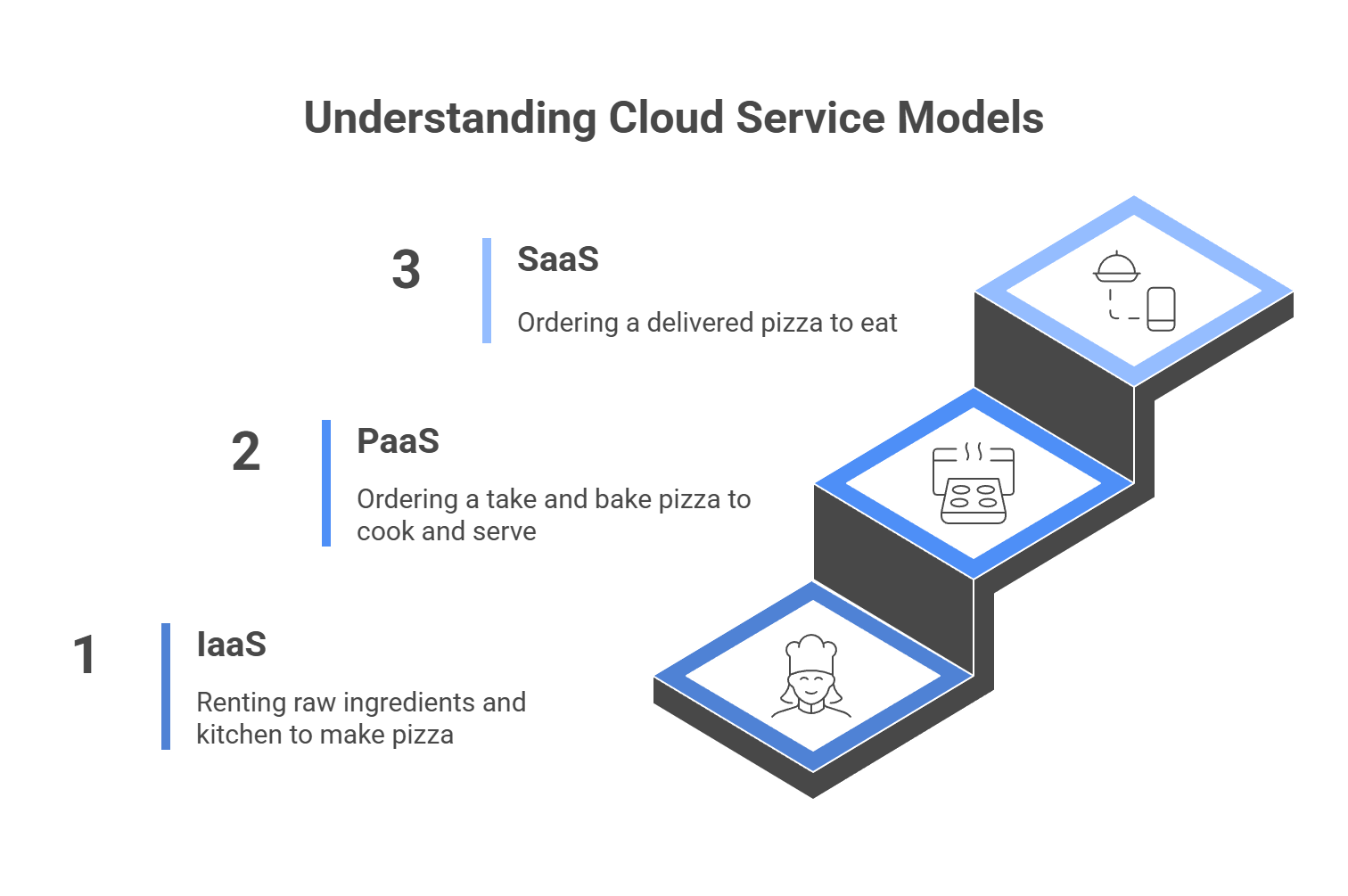
Before you can build, you need to know what you’re building on. Cloud services are sold in three main layers. The easiest way to understand them is with the “Pizza as a Service” analogy.

Cloud Service Models

1. IaaS (Infrastructure as a Service):

  • The Analogy: You rent the raw ingredients (flour, tomatoes, cheese) and the kitchen. You have to make the pizza, bake it, and serve it yourself.
  • The Reality: You rent the fundamental building blocks of computing: virtual servers, storage, and networking. You are responsible for installing the operating system, managing databases, and building the application. This offers maximum control.
  • Examples: Amazon Web Services (AWS) EC2, Google Compute Engine.

2. PaaS (Platform as a Service):

  • The Analogy: You order a “take and bake” pizza. The pizza is made for you, but you cook it in your own oven and serve it at your own table.
  • The Reality: The provider gives you the hardware and the development platform (like the operating system, web server, and databases). You just focus on building and running your own application code. This is a popular choice for developers.
  • Examples: Heroku, Google App Engine.

3. SaaS (Software as a Service):

  • The Analogy: You order a pizza delivered to your door. You just eat it.
  • The Reality: You are simply a user of the finished software. The provider manages the application, the platform, and the infrastructure.
  • Examples: Netflix, Google Docs, Slack.

For cloud app development, we are typically focused on IaaS and PaaS.

The Foundations: Cloud Deployment Models (Public, Private, Hybrid)

Next, you have to decide where your cloud infrastructure will live.

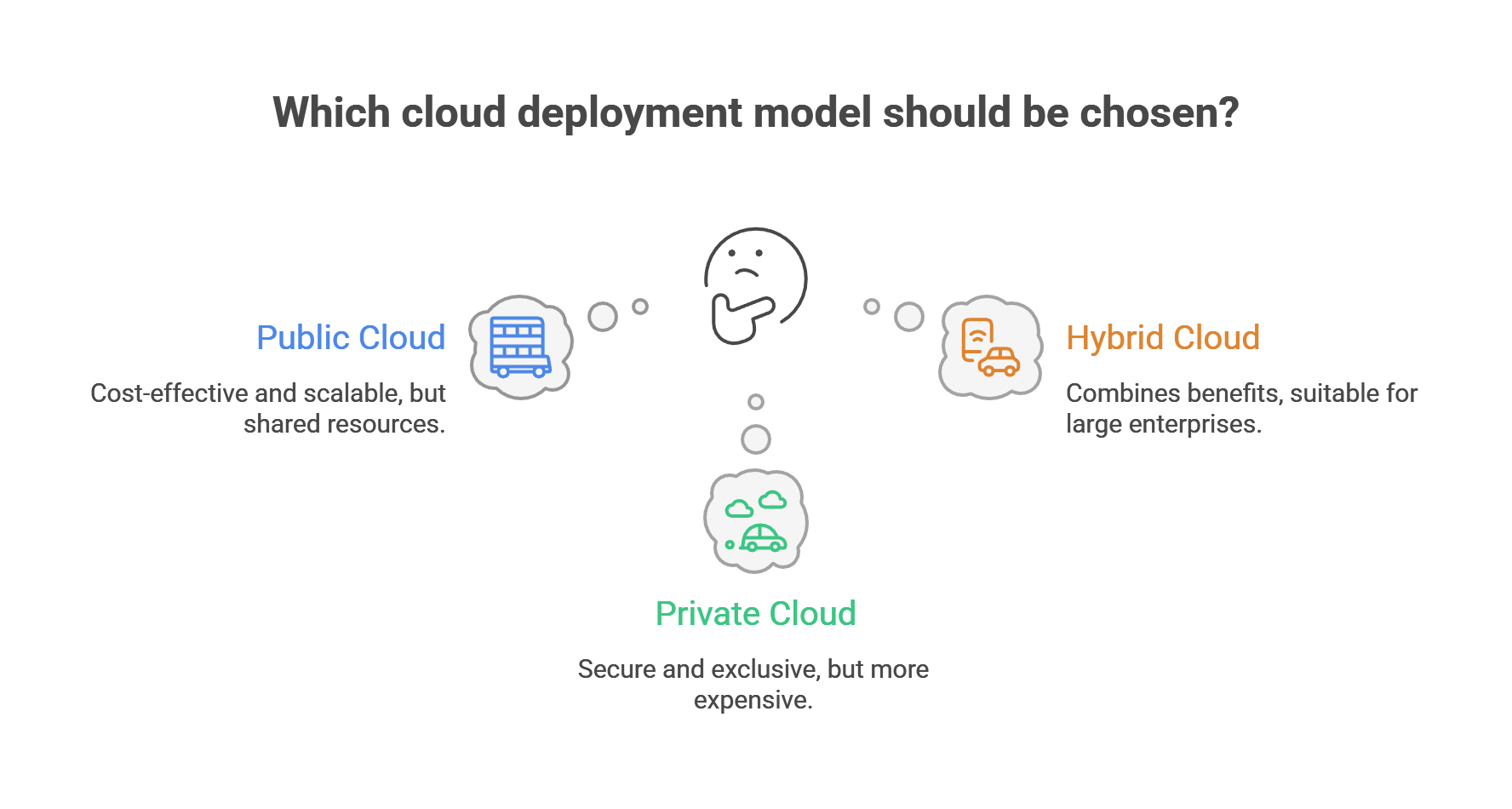
Cloud Deployment Models

1. Public Cloud:

  • The Analogy: Taking a public bus. It’s cost-effective and you share it with other people.
  • The Reality: This is the most common model. The infrastructure is owned and operated by a third-party provider (like AWS, Google, or Azure) and delivered over the internet. You share the hardware with other organizations (called “tenants”). It is highly scalable and cost-effective.

2. Private Cloud:

  • The Analogy: Owning your own car. It’s exclusively yours, giving you total control and security, but it’s more expensive and you are responsible for maintenance.
  • The Reality: The cloud infrastructure is built and operated exclusively for a single organization. This is often used by government agencies, financial institutions, or any company with extreme security and data privacy requirements.

3. Hybrid Cloud:

  • The Analogy: Using a ride-sharing app for your daily commute but owning a car for family trips. You use the best tool for the job.
  • The Reality: This is a combination of both public and private clouds, bound together by technology. A company might keep its sensitive customer data on a private cloud but use the public cloud to run its website, which needs to handle unpredictable traffic spikes. This is the most common strategy for large enterprises.

The “What”: Cloud-Based vs. Cloud-Native

With those foundations in mind, we can now understand the most important strategic choice: how you build your app. Not all “cloud” apps are created equal.

  • Cloud-Based (The “Lift and Shift”): This is like taking a traditional, monolithic application (one big block of code) and moving it from a private, on-premise server to a virtual server in the cloud (IaaS). The app isn’t changed; it’s just relocated. It gets some benefits, like not having to manage physical hardware, but it can’t fully leverage the cloud’s power.
  • Cloud-Native (The “Born in the Cloud”): This is the true “cloud app development.” These applications are built from the ground up to live in the cloud. They are designed as a collection of small, independent services (microservices) that work together. This structure is what unlocks the incredible benefits of scalability, resilience, and speed.

When people talk about the “magic” of the cloud, they are almost always talking about cloud-native development.

The “Why”: Why Cloud App Development Matters

Moving to a cloud-native model isn’t just a trend; it’s a core business strategy. Here are the primary reasons why it has become so critical.

1. Unmatched Scalability and Elasticity

  • The Problem: A traditional app on a single server has a limit. If your app is featured on the news, a traffic spike could crash your server. To prevent this, you’d have to buy powerful, expensive servers just in case, meaning they sit idle 99% of the time.
  • The Cloud Solution: Cloud-native apps can scale elastically. They can automatically request more resources when traffic spikes and then release them when traffic dies down. You get exactly the power you need, precisely when you need it.

2. Significant Cost-Effectiveness

  • The Problem: On-premise servers are a Capital Expenditure (CapEx). You have to pay huge upfront costs for hardware, electricity, cooling, and IT staff.
  • The Cloud Solution: The cloud moves this to an Operational Expenditure (OpEx), or a “pay-as-you-go” model. You trade a massive upfront investment for a variable, predictable monthly bill that reflects your actual usage.

3. Incredible Speed and Agility

  • The Problem: In a traditional monolithic app, making one small change (like updating the “checkout” button) requires testing and re-deploying the entire application. This process could take weeks or months.
  • The Cloud Solution: With microservices, you can update just one small, independent service. This agility is crucial for areas like competitive application development for iphone, where frequent updates are expected by users. This, combined with automated processes (called DevOps), allows teams to deploy updates, fix bugs, and launch new features in days, hours, or even minutes.

4. High Reliability and Resilience

  • The Problem: If your single server fails, your entire application goes down.
  • The Cloud Solution: Cloud-native apps are distributed across a vast, global network of servers. If one server (or even an entire data center) goes down, traffic is automatically rerouted to a healthy one. Furthermore, because the app is made of microservices, one failing service (like the “recommendations” feature) won’t crash the rest of the app (like the “play video” feature).

Also Read: Web Apps vs. Cloud Apps: Which is Right for You?

The Proof: Insights and Stats That Don’t Lie

The shift to the cloud is not a small one; it’s a global economic transformation. These numbers help tell the story:

Could Computing Market Growth

$2.3 Trillion Market: The global cloud computing market was valued at over $700 billion in 2024 and is projected to skyrocket to over $2.3 trillion by 2030. This shows it’s not a niche market but the future of all IT.

The Data Explosion: By 2025, it’s estimated that the world will be storing over 200 zettabytes of data (a zettabyte is a trillion gigabytes). The cloud is the only practical way to store, manage, and process this enormous volume.

A Boost in Security: While some fear the cloud is less secure, the opposite is often true. Cloud providers have world-class security teams. In fact, a high percentage of businesses (by some reports over 90%) note significant improvements in their security after migrating to the cloud.

Also Read: A Guide to Avoiding Common Pitfalls in AWS Migrations

The “How”: Key Components of a Cloud-Native App

How do developers achieve this flexibility and speed? They use a specific set of tools and architectures.

  • Microservices: This is the architectural style. Instead of one giant, tangled “monolith,” the application is broken into dozens of small, independent services. Each service handles one job (e.g., “user authentication,” “payment processing”) and can be scaled independently. Many custom app development company now specializes in this microservice architecture to build scalable solutions.
  • Containers (like Docker): Think of a container as a standardized, lightweight “box” that holds a single microservice and all its dependencies. This “box” can run anywhere, from a developer’s laptop to the cloud, ensuring it always works the same way.
  • Orchestration (like Kubernetes): If you have thousands of “boxes (containers) running, you need a manager. Kubernetes is the market-leading tool that automatically manages the entire lifecycle of your containers: starting them, stopping them, scaling them, and healing them if they fail.
  • DevOps & CI/CD: This is the cultural and process part. DevOps unites the Development (Dev) and Operations (Ops) teams. They use a Continuous Integration/Continuous Delivery (CI/CD) pipeline. This automated workflow builds, tests, and deploys code, allowing for rapid and reliable updates.

Conclusion: It’s Not “If,” It’s “When”

Cloud app development isn’t just about saving money on servers. It’s about fundamentally re-architecting your business to be more agile, resilient, and competitive. It allows a small startup to use the same world-class infrastructure as a global enterprise.

The future of software isn’t coming to the cloud; it’s already being built on it.

Build Engaging Mobile Games

The mobile gaming industry is a global powerhouse. In 2024, it generated over $111 billion in revenue, accounting for a staggering 49% of the entire global video game market. At the heart of this explosion is Android, the operating system that powers over 70% of the world’s smartphones. The opportunity is massive.

But this opportunity comes with a fierce challenge.

Publishing a game on the Google Play Store is easy. Getting someone to download it is hard. Getting them to keep playing it is the true boss battle. The mobile market is defined by the “leaky bucket” problem:

  • Insight: On average, a mobile game loses over 70% of its players after just one day.
  • Insight: After 30 days, only about 3.2% of the original players are still active.

Success on Android isn’t just about building a functional game; it’s about building an engaging one. This guide will walk you through the key strategies, tools, and steps to create a game that hooks players and keeps them coming back.

Part 1: The Blueprint of Engagement: What Makes a Game “Sticky”?

Before you write a single line of code, you must understand what makes a game engaging. It’s not graphics or a complex story. It’s psychology.

1. The Core Loop (The 30-Second Hook)

The core loop is the most critical element of your game. It’s the repeatable cycle of actions that players perform. A strong core loop is simple, satisfying, and makes the player want to do it one more time.

It typically has three parts:

  • Action: The player does something (e.g., matches 3 gems, taps to jump, attacks a monster).
  • Reward: The game responds with a positive reward (e.g., gems clear, points are scored, loot drops).
  • Progression: The reward allows for a minor, visible upgrade (e.g., an experience bar fills, a new power-up is earned, a “level complete” screen appears).

If this 30-second loop isn’t fun on its own, no amount of flashy graphics will save your game.

2. The First Five Minutes: Master the Onboarding

You have one chance to make a first impression. A player’s first session determines if they will ever open your app again.

  • Do: Use an interactive, playable tutorial. Teach mechanics as the player needs them.
  • Don’t: Front-load your game with text boxes, complex menus, or a long story.
  • Goal: Make the player feel smart, capable, and rewarded within the first 60 seconds.

3. The Power of Progression

Engagement is driven by a constant sense of forward momentum. Players need to feel like their time is being respected and rewarded.

  • Short-Term Goals: Daily logins, daily challenges, “first win of the day” bonuses.
  • Mid-Term Goals: Leveling up, unlocking a new character, completing a world.
  • Long-Term Goals: Reaching the max level, topping a leaderboard, collecting every item.

4. “Game Juice”: Making it Feel Good

Juice” refers to the layer of polish that makes a game feel alive. It’s the collection of small, non-essential details that provide satisfying feedback. Examples include:

  • Sound: A rewarding “cha-ching” for collecting a coin.
  • Visuals: Particle effects, screen shake when you land a heavy hit, or bouncy animations.
  • Feedback: The controller vibrating or your phone giving a slight haptic buzz.

A “dry” game (no juice) feels flat and lifeless. A “juicy” game feels responsive and fun.

Part 2: Your Toolkit: Choosing the Right Engine

You don’t need to build a game from scratch. A game engine provides the tools for rendering, physics, audio, and more. For Android, three engines dominate the market.

Engine

Best For Key Features

Popular Examples

Unity Everything (2D & 3D) Uses C#. Powers over 70% of mobile games. Its popularity makes it easier to hire Unity developer talent. Excellent cross-platform support. Genshin Impact, Pokémon GO, Call of Duty: Mobile
Unreal Engine High-Fidelity 3D Uses C++ & Blueprints (visual scripting). Unmatched graphical power. Steeper learning curve. Fortnite Mobile, PUBG Mobile, Rocket League Sideswipe
Godot 2D & Indie Games Uses GDScript (Python-like). 100% free and open-source (no royalties). Lightweight and fast. Usagi Shima, Brotato

What about Native (Kotlin/Java)? You can build a game using Android’s native languages, but it’s a much more difficult path for complex titles. This approach is often taken by a specialized Kotlin App Development Company for “gamified” apps or simple 2D puzzles, rather than for full-fledged 3D games.

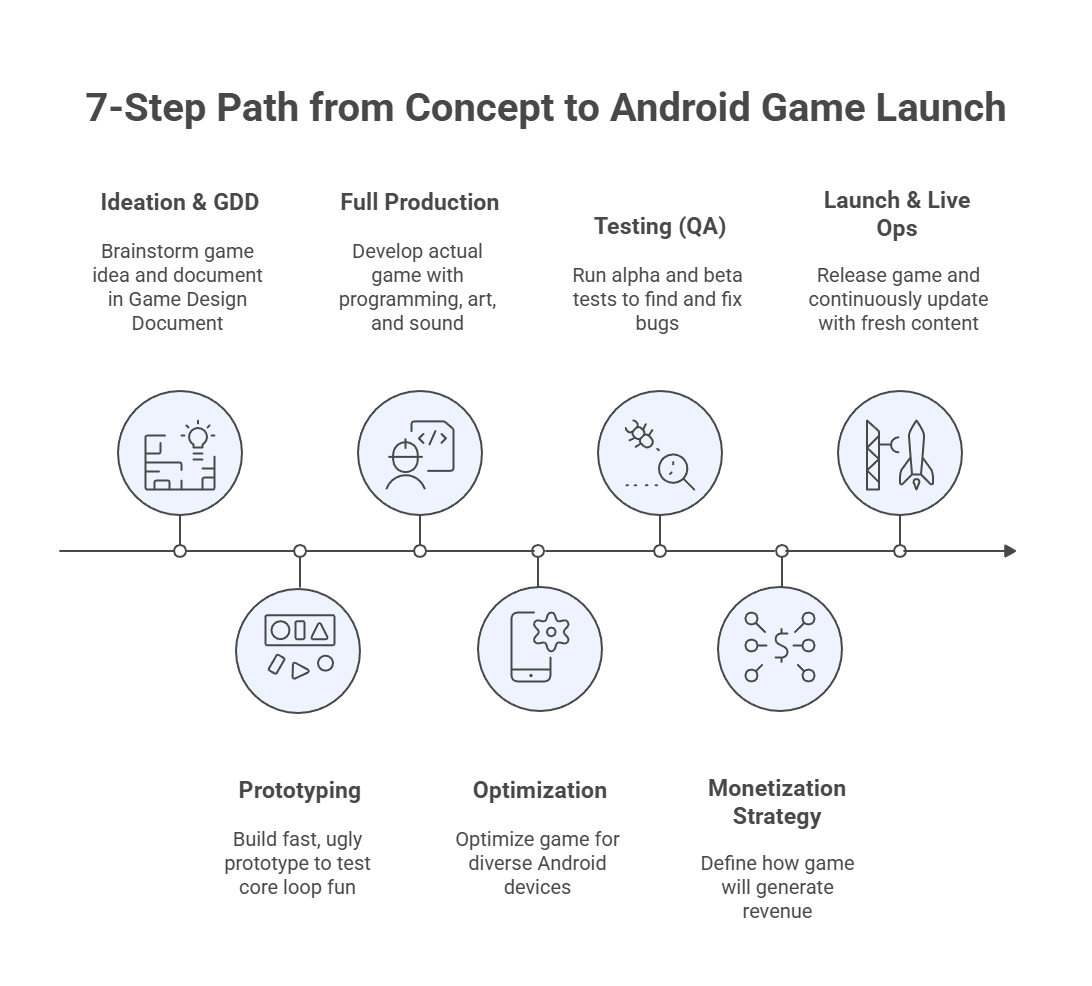
Part 3: The 7-Step Path from Concept to Launch

Here is a simplified roadmap for developing your Android game.

7-Step Path from Concept to Launch

Step 1: Ideation and the GDD

Your idea is the spark. Is it a puzzle game? A fast-paced action game? A sprawling RPG? Once you have your idea, write it down in a Game Design Document (GDD). This document is your game’s bible, detailing the core loop, art style, target audience, and monetization plan.

Step 2: Prototyping

This is the most important technical step. Using simple shapes (cubes, circles), build a fast, ugly prototype that proves your core loop is fun. If you can’t make it fun with simple squares, it won’t be fun with detailed 3D models.

Step 3: Full Production

This is the long haul. Now you and your team (or just you) build the actual game. Many creators with a clear GDD choose to partner with an android application development company at this stage to handle the complex programming, art, and animation. This involves:

  • Programming: Writing the code.
  • Art & Animation: Creating the 2D sprites or 3D models.
  • Sound Design: Making the music and sound effects.

Step 4: Optimization (The Android-Specific Challenge)

Unlike developing for one or two iPhone models, Android is a “fragmented” market with thousands of devices. Your game must run on high-end flagships and low-cost budget phones.

  • Optimize Textures: Compress images to save memory.
  • Manage Draw Calls: Reduce the number of objects on screen.
  • Test on Real Devices: Emulators don’t tell the whole story. Test on real low-spec and high-spec phones.

Step 5: Testing (QA)

Before you launch, you must find and fix bugs. The Google Play Console makes it easy to run closed alpha (internal) and beta (public) tests. Get real player feedback and fix what’s broken.

Step 6: Define Your Monetization Strategy

How will your game make money?

  • In-App Purchases (IAPs) (62% of revenue): The dominant model. Selling cosmetic items (skins), currency, or one-time benefits (e.g., “remove ads”).
  • In-App Ads (26% of revenue): Great for “hyper-casual” games. Rewarded Ads (“Watch this ad for 100 coins“) are the most effective and least annoying.
  • Premium (Pay-to-Play): The player pays once upfront. This is a very tough sell on the mobile market.

Step 7: Launch and “Live Ops”

You’re on the Google Play Store! Congratulations. Now the real work begins. An engaging game is not a product; it’s a service.

“Live Ops” (Live Operations) is the secret to long-term retention. It’s the practice of continually updating the game with fresh content.

  • Daily/Weekly Challenges
  • Seasonal Events (e.g., a “Winter” theme in December)
  • New Levels, Characters, or Items
  • Leaderboard Resets

This is what keeps your 3% of loyal players logging in for months, or even years.

Conclusion

Building a game for Android is more accessible than ever, but building a successful one requires a new mindset. The technical challenge is just the beginning. The real challenge is in design, psychology, and service.

Focus obsessively on your core loop. Polish every interaction until it feels “juicy.” And most importantly, treat your launch not as the finish line, but as the starting line.

Shopify Inventory with AI Workflows

Managing inventory is one of the biggest challenges Shopify store owners face, especially as a business grows and order volumes increase. Between updating stock levels, tracking supplier orders, and forecasting demand, manual inventory management can quickly become time-consuming, error-prone, and costly.

That’s where AI-powered inventory automation comes in. By using artificial intelligence and workflow automation tools, Shopify merchants can streamline operations, prevent stockouts, and make smarter inventory decisions while saving hours every week. Many businesses that invest in Shopify development services are now combining them with automation tools to create more efficient, data-driven e-commerce operations.

In this article, we’ll explore how to automate Shopify inventory using AI workflows, why it matters, and which tools and strategies can help you scale effectively.

Why Inventory Automation Matters for Shopify Stores

Inventory management can make or break an online business. Many retailers admit that inventory mismanagement is one of their biggest operational challenges. A large portion of businesses lose revenue each year due to stock inefficiencies and human errors.

Manual inventory updates often lead to mistakes and limited growth potential. Automation, on the other hand, helps businesses:

  • Reduce human error by automatically syncing inventory data across all sales channels
  • Eliminate stockouts and overselling with real-time tracking
  • Optimize cash flow by avoiding overstocking
  • Enhance customer satisfaction through accurate product availability
  • Save time by automating repetitive tasks such as restocking alerts and supplier communications


For smaller brands that work with freelance Shopify developers, automation tools can be easily integrated into their stores without complex coding or expensive custom systems.

How AI Workflows Transform Shopify Inventory Management

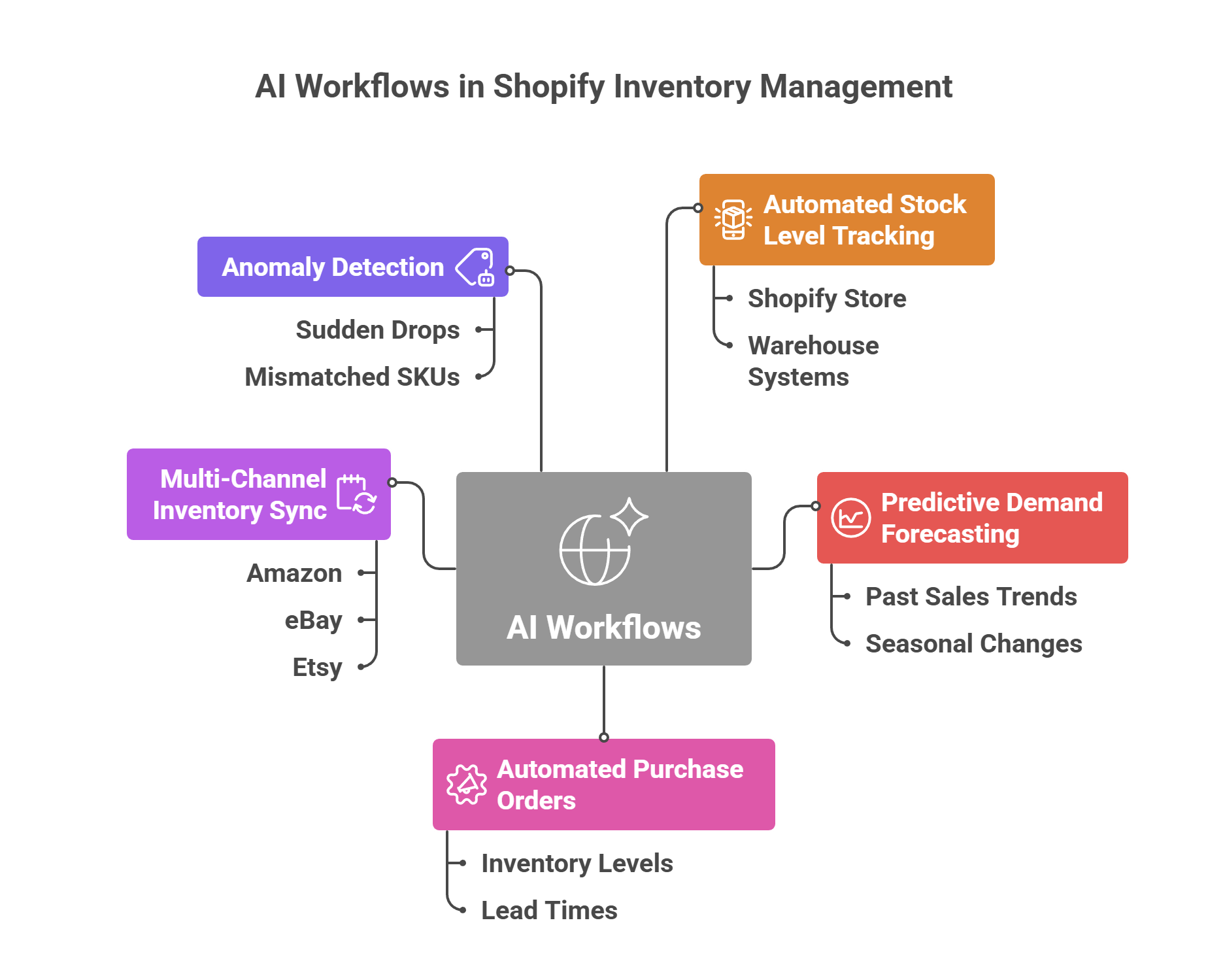
AI workflows take automation to the next level. Instead of just following preset rules, they analyze business data, identify patterns, and make smarter, data-driven decisions. Here’s how AI can change the way Shopify merchants manage inventory.

Ai Shopify Inventory Management

Automated Stock Level Tracking

AI tools connect directly to your Shopify store and warehouse systems to track stock levels in real time. When inventory drops below a set threshold, the system automatically creates reorder workflows, ensuring that your best-selling products are always available.

Predictive Demand Forecasting

By analyzing past sales trends, seasonal changes, and even factors like holidays, AI can predict what products are likely to sell next. For example, if you sell outdoor gear, the system may suggest increasing stock before summer based on past patterns. Retailers that use predictive forecasting often see significant reductions in stockouts and excess inventory.

Automated Purchase Orders and Supplier Communication

AI can automatically create purchase orders and send them to your suppliers based on inventory levels and lead times. This not only saves time but also ensures that you maintain smooth relationships with vendors and avoid delays in restocking.

Multi-Channel Inventory Sync

If you sell on multiple platforms like Amazon, eBay, or Etsy, AI-powered systems can sync inventory across all channels instantly. When a product sells on Shopify, your stock levels are automatically updated everywhere else, keeping your listings consistent and accurate.

Anomaly Detection and Instant Alerts

AI can detect unusual inventory movements, such as sudden drops or mismatched SKUs, and alert you immediately. This helps prevent costly errors before they impact customers or profits.

Top AI Tools and Integrations for Shopify Inventory Automation

Here are some powerful tools that help Shopify stores automate inventory processes:

Tool Key Features Best For
Shopify Flow Automates tasks like restock alerts, tagging, and order routing Shopify Plus users
Stocky (by Shopify) Predictive restocking and demand forecasting Small to mid-size stores
Cin7 Centralized inventory sync and automation Omnichannel retailers
Katana AI-powered inventory and manufacturing control DTC brands and makers
Zapier / Make (Integromat) Connects Shopify with AI tools for custom workflows Custom automation setups
Skubana Comprehensive order and inventory automation Large-scale operations

AI integration in e-commerce is expanding rapidly, with more businesses exploring AI software development services to create custom tools that integrate predictive analytics, workflow triggers, and supply chain optimization directly into Shopify.

Example of an AI Inventory Workflow

Here’s a simple example of how an AI-driven inventory workflow might function:

  1. AI monitors inventory levels across all SKUs in real time.
  2. The system predicts upcoming demand using historical data.
  3. When stock falls below a defined threshold, it automatically creates a purchase order.
  4. The supplier is notified instantly through email or API connection.
  5. Once new stock arrives, Shopify and other channels are updated automatically.
  6. AI reviews weekly performance data and provides insights on sales and stock turnover.


Many e-commerce businesses that adopt AI-driven workflows report cutting manual workload by more than half and increasing inventory accuracy significantly.

The Return on Investment from AI Inventory Management

AI-driven automation doesn’t just improve efficiency, it directly impacts profitability. Businesses that automate inventory operations often experience:

  • Faster order fulfillment
  • Improved cash flow from reduced overstock
  • Lower operational costs due to fewer manual errors


With automation handling the backend, business owners can focus on product development, marketing, and customer engagement, the areas that drive true growth.

How to Get Started with AI Inventory Automation on Shopify

If you’re ready to bring AI automation into your Shopify workflow, here’s how to begin.

  • Evaluate your current process and identify areas where you spend too much time or make frequent errors.
  • Select an automation platform such as Shopify Flow, Katana, or Cin7 based on your store’s size and complexity.
  • Integrate forecasting tools that use AI to analyze past sales and predict future demand.
  • Start small by automating low-stock alerts or simple reorder tasks.
  • Monitor and refine the system over time as your AI learns from sales and performance data.

Final Thoughts

Automating Shopify inventory with AI workflows is more than just a time-saver, it’s a strategic upgrade that empowers your business to scale efficiently and intelligently.

AI automation ensures your stock data stays accurate, your operations stay organized, and your customers stay satisfied. For any growing Shopify store looking to compete in today’s fast-moving e-commerce environment, AI-driven inventory automation is no longer optional, it’s the key to sustainable success.

Symfony vs Laravel

When it comes to choosing a PHP framework for your next web application, the debate between Symfony and Laravel remains one of the most persistent. Each has its strengths and trade-offs, and as a business, you’ll want to assess cost, talent availability, and long-term ROI before committing. This guide dives into these aspects in detail, backed by insights and market data to help you make an informed decision.

1. Popularity & Talent Market

Why This Matters

Talent availability and community size directly impact your hiring cost, your project’s agility, and your long-term maintenance capability. A limited developer pool can slow your progress and inflate costs, especially for complex systems.

What the Data Shows

Laravel:

Laravel dominates the PHP landscape, powering over four times as many live websites as Symfony. In various datasets, Laravel holds around 35.8% market share among PHP frameworks, while Symfony trails at roughly 15%.
According to developer surveys, Laravel usage among respondents averages 7.9%, while Symfony sits at 3.2%, showing Laravel’s broader reach and accessibility.

Laravel’s popularity also stems from its gentle learning curve and robust ecosystem. Many startups and SMEs prefer it because it allows faster onboarding and quicker project delivery.

Symfony:

Symfony is more enterprise-oriented and component-driven, favored by organizations that require complex, long-term architectures. Its modular design offers flexibility and control but demands a higher skill level from developers. Large companies often use Symfony for mission-critical applications due to its long-term support (LTS) and performance stability.

Talent Implications

If your project requires quick staffing, Laravel gives you the advantage since it’s easier and more affordable to hire Laravel developers thanks to the broader global talent pool. Symfony, on the other hand, may require more time and budget to find senior-level experts, but the trade-off is often stronger long-term reliability and code quality.

2. Development & Infrastructure Cost

Upfront and Ongoing Cost Factors

Both frameworks are open-source, but your total cost of ownership includes:

Development and Infrastructure Cost

  • Developer salaries or hourly rates
  • Ramp-up time and learning curve
  • Infrastructure and hosting overhead
  • Maintenance and upgrade cycles 

Laravel’s simplicity and extensive documentation make it ideal for MVPs and mid-sized projects. It reduces development time significantly, helping businesses move from idea to execution faster. This is one reason many startups partner with a Laravel Development company to accelerate go-to-market timelines.

Laravel’s vast library ecosystem and third-party integrations further minimize custom coding needs, saving both time and cost.

Symfony: Higher Initial Cost, Long-Term Payoff

Symfony has a steeper learning curve and demands more initial setup. However, its component-based structure pays off over time. Its optimized performance under heavy load conditions makes it ideal for enterprise-grade systems that expect long lifecycles.

Benchmarks indicate that while Laravel may load faster for smaller operations (around 60ms per request), Symfony demonstrates superior scalability, lower memory usage (approximately 38MB vs. Laravel’s 45MB), and reduced CPU load under stress. Over time, this can translate to substantial infrastructure savings.

3. Long-Term ROI (Return on Investment)

Laravel – Faster Business Returns

Laravel excels at rapid prototyping and iteration, leading to faster feature releases and quicker validation of business ideas. Its large ecosystem and active community reduce risk and ensure consistent updates. However, for large, complex enterprise applications, Laravel may accumulate technical debt if not carefully architected.

Symfony – Built for Longevity

Symfony’s modular and standardized architecture results in more maintainable, scalable systems. For projects expected to run beyond 10 years or handle heavy traffic, Symfony often provides better ROI through reduced maintenance and infrastructure costs.

ROI Snapshot

Scenario Laravel Wins

Symfony Wins

Fast MVP / Startup budget

✔️

Large developer pool

✔️

Short to medium lifecycle

✔️

Enterprise-grade, long lifecycle

✔️

Complex architecture

✔️

Lower infrastructure cost at scale

✔️

4. Strategic Guidelines for Framework Selection

Ask These Key Questions

  • What’s your project’s expected lifetime and scalability goal?
  • Do you prioritize fast deployment or long-term structure?
  • What’s the local developer market availability for each framework?
  • Will your system handle complex integrations or enterprise security needs?

If your goal is to build quickly and validate fast, Laravel is the clear winner. But if your vision involves a large-scale enterprise system with extensive functionality and strict stability, Symfony may justify its higher initial cost.

For businesses offering Symfony Development Services, this framework’s robustness allows them to attract enterprise clients seeking long-term value and architectural reliability.

5. Cost & ROI: The Business Perspective

Upfront Cost Efficiency

Laravel often leads in cost-effectiveness for early-stage or budget-conscious projects. Its speed of development can reduce total project cost by up to 30–40% compared to Symfony for similar MVP-scale products.

Talent Market Edge

Since Laravel developers are more abundant, companies can scale teams quickly and maintain cost efficiency. This helps custom application development companies meet client deadlines with greater flexibility.

Long-Term Value for Enterprises

Symfony’s architectural discipline helps businesses minimize technical debt and extend application lifespan. For high-traffic or complex systems, this can lead to significantly lower long-term operational costs.

6. Summary & Recommendation

  • Laravel: Easy to learn, cheaper to hire, and great for rapid development. Perfect for startups, MVPs, and small to mid-size projects.
  • Symfony: Complex but powerful, ideal for enterprise-scale, mission-critical applications demanding long-term stability and scalability.

If you’re aiming for speed, lower cost, and faster market entry, Laravel is the pragmatic choice.
If you need a reliable, scalable architecture with strong long-term ROI, Symfony is your go-to.

7. Final Thoughts

Framework choice isn’t just a technical decision; it’s a strategic business move that affects hiring, cost, maintenance, and ROI. Laravel offers faster returns and broader accessibility, while Symfony provides enduring value and structural integrity.

The key lies in aligning your business objectives with the framework’s strengths. Whether you’re looking to scale fast or sustain over decades, choose the ecosystem that best supports your goals and the developers who will build your vision for the long run.

Ethical AI in E-Commerce

Ethical AI in e-commerce is the practice of designing, deploying, and managing artificial intelligence systems in a way that is fair, transparent, secure, and accountable. It ensures your store’s AI tools, like chatbots, recommendation engines, and pricing algorithms, operate without bias, respect customer privacy, and build long-term trust.

This approach is critical for avoiding new legal penalties, building customer loyalty, and creating a sustainable, resilient brand.

Why Is Ethical AI in E-Commerce So Important Right Now?

Ignoring AI ethics is no longer an option. The landscape is changing rapidly, and these factors directly impact your business:

  • New Regulations Are Here: The EU AI Act sets global standards for AI use, requiring risk management, human oversight, and detailed documentation. Non-compliance can result in severe penalties.
  • Active Enforcement: In the United States, the FTC is targeting deceptive AI. This includes AI-generated fake reviews, misleading product claims, and unfair automated decisions. This impacts every merchant, from a small store to a major Ecommerce Solutions Provider in USA.
  • Customer Trust is at Stake: Shoppers are increasingly wary of how their data is used. Transparent, ethical AI practices are a powerful differentiator that builds brand loyalty.
  • Competitive Pressure: Your competitors are already using AI. Using it ethically is how you de-risk your strategy and build a long-term advantage.

What Are the Core Principles of Ethical AI for Merchants?

Ethical AI” isn’t abstract. It breaks down into six concrete practices you can implement in your store.

1. Transparency & Disclosure

What it is: Being open and honest with customers about when they are interacting with an AI.

  • Action: Clearly label AI chatbots (e.g., “You’re chatting with our helpful AI assistant“).
  • Action: Disclose if product descriptions or images are AI-generated (e.g., “Description generated by AI and reviewed by our team“).

2. Data Privacy & Minimization

What it is: Collecting only the customer data you absolutely need and protecting it.

  • Action: Don’t collect sensitive data unless essential.
  • Action: Anonymize or delete customer data once it’s no longer needed for its original purpose.

3. Fairness & Bias Mitigation

What it is: Actively ensuring your AI models do not discriminate against or unfairly treat any group of customers.

  • Action: Test your AI for biased outcomes (e.g., do your recommendations favor products for one demographic over another?).
  • Action: Use diverse and representative data when training your models.

4. Accuracy & Reliability (Guardrails)

What it is: Ensuring your AI provides correct information and has safety checks for when it’s wrong.

  • Action: Set “confidence thresholds” for your AI. If it’s not sure of an answer, it should fall back to a human support agent.
  • Action: This is critical for high-impact decisions like refunds or product safety advice. When building custom tools or sourcing AI Software Development Services, this fallback is non-negotiable.

5. Honesty & Non-Deception

What it is: A bright red line. Never use AI to deceive customers.

  • Action: Do not create or post AI-generated fake reviews, testimonials, or endorsements. This is a primary target for regulators like the FTC.

6. Accountability & Recourse

What it is: Giving customers a clear path to appeal an AI’s decision to a human.

  • Action: Provide a simple “request human review” button for automated decisions (like a denied refund).
  • Action: Be able to explain why your AI made a certain recommendation (e.g., “Recommended because you viewed [Product X]”).

How Does Ethical AI Improve Your E-Commerce Business?

Ethical practices are a direct investment in your bottom line.

  • Builds Customer Trust: Trust is a conversion metric. Customers who trust your brand are more likely to share their data, which leads to better personalization and higher customer lifetime value (LTV).
  • Reduces Legal Risk: Adhering to ethical standards is your best defense against massive fines from new laws like the EU AI Act and FTC enforcement actions.
  • Improves Brand Reputation: A single PR disaster from a biased or “creepy” AI can destroy brand value. Ethical governance makes your brand resilient.
  • Drives Better Outcomes: Fair, accurate, and reliable AI simply works better. It provides more helpful recommendations and support, leading to higher customer satisfaction.

Your 10-Point Ethical AI Implementation Checklist

Use this checklist to build your governance plan from the ground up.

  1. Map Your AI Footprint: List every place you use AI (chat, personalization, pricing, review moderation, fraud detection).
  2. Classify by Risk: Label each system as “high-impact” (e.g., pricing, refunds) or “low-impact.” Prioritize high-impact systems first.
  3. Create an “AI Use” Disclosure: Add a simple, clear page to your site footer explaining your approach to AI.
  4. Adopt Data Minimization Rules: Write and enforce a policy on what data you collect and how long you keep it.
  5. Test Before Deploying: Run fairness checks on new models. Look for unexpected results across different customer groups.
  6. Build Feedback Loops: Add a simple “Report an issue” or “Was this helpful?” button to your AI tools.
  7. Train Your Support Team: Your human staff must know the AI’s limitations and have a clear process for escalating AI-related problems.
  8. Review Vendor Contracts: Whether you use a third-party app or work with a Shopify development company, check their contracts. What do they say about data security, liability, and fairness?
  9. Label AI-Generated Content: If a product description, image, or ad is fully AI-generated, mark it.
  10. Document Everything: Keep records of your models, data, and risk assessments. This is a key requirement for new AI laws.

Common Ethical AI Pitfalls in E-Commerce (And How to Fix Them)

Use Case Common Pitfall (The Problem) The Ethical Fix (The Solution)
Personalization The algorithm becomes “creepy,” using sensitive data that makes users uncomfortable. Use Opt-Outs & Non-Sensitive Data. Stick to purchase history and viewed items. Always provide an “opt-out” and a “Why this?” link.
Dynamic Pricing The model shows wildly different and unfair prices to similar customers, leading to a PR disaster. Cap Swings & Test for Fairness. Apply rules to prevent discrimination and put hard caps on price fluctuations.
Chatbots The bot confidently gives incorrect product safety, medical, or legal advice, which a customer trusts. Limit the Scope & Disclose Loudly. Clearly state “I’m an AI bot.” Program it to never answer high-stakes questions and to immediately route to a human.
Content Generation AI-generated product images or descriptions are misleading or make false claims about a product. Require Human Review. All AI-generated content that faces a customer must be reviewed by a human for accuracy.
Review Moderation The AI filter incorrectly hides legitimate negative reviews (looks like censorship) or allows fake 5-star reviews. Use a Human-in-the-Loop. Combine automated detection with human moderation. Be transparent about your moderation policy.

What About New “Conversational Commerce” (Like Selling in ChatGPT)?

This is the newest ethical frontier for merchants. Features like OpenAI’s “Instant Checkout“, which allows merchants on platforms like Shopify and Etsy to sell products directly within a ChatGPT conversation, create urgent new questions.

If you participate in this new “agentic commerce,” all the principles from this guide apply:

  • Transparency: Is it 100% clear to the customer that they are buying from you (the merchant) and not from OpenAI? You are still the merchant of record, and the customer must understand that.
  • Fairness: How does the AI rank your product against a competitor’s? OpenAI states rankings are based on relevance, not fees, but this “algorithmic fairness” is a new “black box” that merchants must monitor.
  • Data Privacy: What purchase data is OpenAI keeping? How is the customer’s payment and shipping info handled between you, OpenAI, and the payment processor (like Stripe)? You must understand these data flows to ensure you are compliant and your customer’s data is safe.

Frequently Asked Questions

Q: What is the EU AI Act?

A: The EU AI Act is a comprehensive new law that regulates AI systems based on their risk level. E-commerce tools like chatbots, recommendation engines, and credit scoring systems may be classified as “high-risk,” requiring strict compliance with rules on data quality, transparency, human oversight, and documentation.

Q: Do I have to disclose every AI tool I use?

A: The best practice is to disclose any AI that directly interacts with a customer or makes a decision about them. This includes chatbots, personalization, and pricing. AI used for internal-only tasks (like warehouse optimization or custom scripts built by freelance WooCommerce developers) is less critical to disclose to customers.

Q: Can I use AI to write positive product reviews for my store?

A: No. Absolutely not. This is a deceptive practice and a form of fake endorsement. Regulators like the FTC are actively targeting this, and it will destroy your customer trust.

Q: How do I balance personalization with customer privacy?

A: The key is customer control.

  1. Default to minimal data collection.
  2. Explain the benefit of personalization (e.g., “Help us show you more relevant products“).
  3. Provide a clear, easy, one-click way to opt out.

How to Get Started With Ethical AI This Week

You don’t need to solve everything at once. Take these five small steps to begin:

  1. Inventory: Make a list of all your AI tools and vendors.
  2. Disclose: Add a simple disclosure to your chatbot (“I’m an AI assistant…”).
  3. Test: Run one quick fairness test on your product recommendation engine.
  4. Review: Read the data and privacy clauses in the contract for your primary AI vendor.
  5. Plan: Create a one-page plan for what to do if your AI makes a public, damaging mistake.
Power BI Connectors vs Custom APIs

In the world of data, getting your information into Power BI is the critical first step. But when you face a data source, you hit a fork in the road: do you use a simple, pre-built connector, or do you venture into the world of custom APIs?

The choice isn’t just technical; it has massive implications for your project’s cost, security, performance, and long-term maintenance. Let’s break down the contenders.

The Contenders: Understanding Your Options

First, “connecting to an API” isn’t a single approach. There are four distinct methods, each with its own strengths.

  1. Built-In Connectors (The “Easy Button”): These are the 150+ options you see in the “Get Data” window, like Salesforce, SQL Server, Google Analytics, and Excel. They are built and maintained by Microsoft or a certified partner.
  2. Third-Party Connectors (The “Specialist”): These are pre-built connectors from vendors to get data from their specific, often niche, applications (e.g., Autodesk, Xero, StreamBIM). Some are “Certified” by Microsoft and appear in “Get Data,” while others require you to download a file and adjust security settings.
  3. The Web API Method (The “Quick & Dirty”): This is the Get Data > Web option. You paste in a URL (an API endpoint), provide an API key, and Power Query’s Web.Contents function pulls the data (usually as JSON or XML) for you to transform.
  4. The Custom Connector (The “Tailor-Made Suit”): This is a formal data connector (.mez file) you build yourself using the Power Query SDK. It’s a reusable, shareable, and secure package that can handle complex logic, authentication, and navigation, making a custom data source feel just like a built-in one.


The real battle is between these last two. Are the speed and simplicity of the Web API method “good enough,” or do you need the power and polish of a true Custom Connector?

The Showdown: A Head-to-Head Comparison

Feature Built-In Connectors Web API Method (Web.Contents)

Custom Connector (SDK)

Development Effort None Low. A few lines of M code. High. Requires M language and SDK knowledge.
Cost Free (included with Power BI) Free (tooling) High. Costs can range from $2,000 to $30,000+, especially when engaging external firms for Power BI Development Services.
Maintenance None (handled by Microsoft) Medium. You must update code if the API changes. High. You own all maintenance and updates.
Authentication Seamless (e.g., logs you in) Limited. Good for basic API keys. Struggles with complex OAuth2. Robust. Full support for OAuth2, API keys, etc.
Security High. Manages credentials securely. Low-Medium. Risk of exposing keys in queries. High. Manages credentials securely, just like a built-in.
User Experience Excellent. User-friendly dialogs. Poor. Requires users to edit code. Excellent. You build a user-friendly UI.
Performance High. Often supports Query Folding. Low. Can’t “fold” queries. Prone to API rate limits. High. Can be built to support Query Folding.
Reusability N/A Poor. Must copy/paste M code. Excellent. Share the .mez file across the organization.

Stats That Matter: Why This Decision Is Crucial

This isn’t just an academic debate. The right connection method directly impacts your bottom line and data reliability.

  • APIs Run the World: Over 83% of all internet traffic is API-based. Your ability to connect to them reliably is no longer optional.
  • Performance is King: A well-built connector that supports Query Folding (pushing transformations back to the source) can be massively faster. In some cases, switching to a native connector has been shown to improve data refresh performance by up to 60%.
  • Cost of Failure: Relying on the “Web API” method can lead to slow, unreliable reports that constantly break. A project team at the construction technology firm Autodesk found that using a proper, certified connector for their 3D model data saved their project managers “multiple hours… every week” that were previously spent wrestling with data.

A Real-World Scenario: The “Web API” Trap

Imagine you need to pull data from your company’s proprietary, in-house project management API, which was created as part of a custom web development project.

Attempt 1: The “Web API” Method

You use Get Data > Web and paste in the API endpoint. You get it working for one report by hard-coding your personal API key into the M code.

The Problems:

  1. Security: Your API key is now in plain text inside the PBIX file.
  2. Authentication: When you publish to the Power BI Service, the scheduled refresh fails because the service doesn’t know how to securely provide the API key.
  3. Usability: Your colleague, Sarah, wants to use this data. You have to send her a text file with the M code to copy and paste.
  4. Performance: The API returns 1,000,000 records. Your report only needs 100, but Power BI must download all 1,000,000 rows first and then filter them, hitting your API’s rate limit and slowing the refresh to a crawl.

Attempt 2: The “Custom Connector” Solution

You invest time in building a true Custom Connector using the SDK.

The Wins:

  1. Security: The connector has a proper authentication flow. When Sarah uses it, she’s prompted to enter her own credentials, which Power BI stores securely.
  2. Usability: The connector appears in her “Get Data” list as “OurCompany Projects.” She sees a simple navigation table, not a line of code.
  3. Performance: You implemented Query Folding. When Sarah filters for “Project X” in the Power BI editor, your connector translates that into an API call (…/api/projects?filter=ProjectX), and the API only sends the 100 rows she needs. The refresh is now seconds, not hours.


That “Custom Connector” solution might seem complex, and that’s okay. The jump from a simple web query to a full-blown, secure, and high-performance connector is significant. This is precisely where a specialist can bridge the gap. YES IT Labs excels at navigating this complexity, helping you build robust, high-performance connectors for your proprietary APIs. We can handle the difficult parts, like secure OAuth2 implementation and performance-critical Query Folding, allowing your team to get the data they need without becoming M-language experts.

The Verdict: A Simple Decision Framework

So, which wins? It depends entirely on your data source.

Winner: Built-In Connector

  • Use when: Your data is in a common, mainstream platform (like Salesforce, SharePoint, or a database like SQL Server or MySQL). If your team has to hire MySQL developers to manage the data, it’s a safe bet there’s a built-in connector for it.
  • The Rule: Always use this first. If a built-in connector exists, use it. Period.

Winner: Third-Party Connector

  • Use when: You use a specific SaaS platform or industry tool (like Xero, Autodesk, or StreamBIM) that offers its own Power BI connector.
  • The Rule: This is the next best thing. It saves you all the development cost and provides a tested, supported solution.

Winner: The “Web API” Method (Web.Contents)

  • Use when: You need a quick, one-off analysis from a public API that uses a simple API key, and you are the only person who will use it.
  • The Rule: This is a “prototyping” tool, not a production solution. As soon as you need to share, schedule, or secure the data, you’ve outgrown this method.

Winner: The “Custom Connector” (SDK)

Use when:

  • You are connecting to a proprietary or in-house API.
  • You need to handle complex OAuth2 authentication securely.
  • You want to provide a user-friendly, reusable connector for your whole team.
  • You need to implement Query Folding to manage large data and avoid API rate limits.


The Rule: This is the professional, enterprise-grade solution for any data source that isn’t already covered by a pre-built connector. The upfront cost is higher, but the long-term gains in security, performance, and usability are almost always worth it.

Python Development Tools

Imagine this: Your startup’s app is exploding in popularity, user traffic doubling overnight, and your team isn’t scrambling in panic mode. Instead, you’re calmly deploying updates that handle the surge like a pro. In 2026, this isn’t a pipe dream. It’s the reality for businesses leveraging Python’s ecosystem. Python’s adoption skyrocketed by 8 percentage points from 2025, cementing its spot as the most wanted programming language among developers. Giants like Netflix, Instagram, and Spotify aren’t just using Python. They’re scaling empires on it, processing billions of requests daily without missing a beat.

Why does Python stand out for business growth? It’s not just hype. It’s backed by real advantages. Python enables 3 to 5 times faster prototyping than languages like Java, slashing time-to-market and letting you iterate on ideas before competitors even boot up their IDEs. With a TIOBE Index share of 27.5 percent, it’s the world’s most popular programming language, drawing a massive talent pool that keeps hiring costs down by up to 30 percent compared to niche languages. Plus, in an era where data drives decisions, 53 percent of Python developers are knee-deep in data exploration and processing, turning raw insights into revenue streams. The web frameworks market alone, fueled by Python, ballooned from $25 billion in 2025 to a projected $200 billion by 2031. That’s proof that scaling with Python isn’t just efficient. It’s a smart investment.

But Python’s magic happens through its tools. These aren’t gimmicks. They’re battle-tested workhorses that streamline workflows, automate the grunt work, and ensure your code grows as fast as your business. Let’s dive into the essentials. We’ll focus on what users like you actually need: practical setups, integration tips, and real-world scaling wins. We’ll cover IDEs for productivity, frameworks for robust apps, data handlers for insights, and deployment powerhouses for going global. For teams eyeing external expertise, Python Software Development Services can bridge skill gaps during rapid expansion.

1. IDEs: Your Command Center for Efficient Coding

Ever felt like your code editor is holding you back during a crunch? Ditch the basics. Top IDEs turn solo devs into scaling superheroes by catching bugs early and integrating with team tools.

  • Visual Studio Code (VS Code): Hands down the world’s most popular IDE, with over 70 percent of developers swearing by it for Python work. Why? Its lightweight design loads in seconds, and extensions like Python IntelliSense, GitLens, and Jupyter make debugging a breeze. For businesses, it shines in collaborative scaling: real-time co-editing via Live Share lets remote teams sync on massive codebases without version conflicts. Pro tip: Pair it with the Black formatter for auto-code styling. That saves hours on reviews as your team grows from 5 to 50 devs.
  • PyCharm: JetBrains’ powerhouse for enterprise-level projects. It’s got built-in support for Django and Flask, plus database tools that visualize queries on the fly. Scaling insight: 85 percent of Python pros use it as their main language tool, crediting its refactoring wizard for handling legacy code migrations without downtime. Cost? Free community edition for startups, professional for $199/year. ROI hits fast with fewer production errors.


These IDEs aren’t just editors. They’re scalability enablers, reducing dev time by 20 to 30 percent through smart autocomplete and testing integrations. When expanding globally, Offshore Software Development services offer cost-effective ways to bolster your IDE-savvy team without overhead.

2. Frameworks: Building Scalable Backends That Won’t Buckle

Your app’s backbone needs to flex under pressure. Python frameworks like these let you go from MVP to million-user platform with minimal rewrites.

  • Django: The go-to for complex, data-heavy apps. Think e-commerce sites or internal dashboards. It’s “batteries-included,” with built-in admin panels, ORM for database scaling, and security features that thwart common attacks. In 2026, it’s the top pick for large companies, powering Instagram’s feeds and NASA’s data pipelines. Scaling hack: Use its caching layer with Redis to handle 10x traffic spikes. One Netflix-inspired tweak reportedly cut load times by 40 percent. Free and open-source, but expect a learning curve for non-web devs.
  • FastAPI: For API-first businesses craving speed, this async framework auto-generates interactive docs (Swagger UI) and validates data on the fly. It’s 3x faster than Flask for high-throughput services, ideal for microservices in AI-driven apps. Business win: Companies like Uber use similar async patterns to process real-time data. FastAPI’s type hints catch errors pre-deploy, slashing debugging by 50 percent. Setup in minutes: pip install fastapi uvicorn. Perfect for scaling prototypes to production.
  • Flask: Lightweight and flexible for smaller teams prototyping fast. It scales via extensions like Flask-SQLAlchemy for databases. Insight: While not as “enterprise-ready” as Django, it’s beloved for quick MVPs. Spotify started here before expanding. Add Gunicorn for production serving, and you’re handling concurrent users effortlessly.


Choose based on size: Flask for agility, Django for structure, FastAPI for performance. Together, they’ve driven Python’s web framework dominance, with the market exploding thanks to their ease.

3. Data Tools: Unlocking Insights to Fuel Growth

Scaling isn’t just about code. It’s about data. Python’s libraries turn spreadsheets into strategic goldmines, with 53 percent of devs relying on them for business intelligence.

  • Pandas and NumPy: The dynamic duo for data wrangling. Pandas handles messy CSVs like a pro, while NumPy crunches arrays at lightning speed. For businesses, they’re game-changers: Analyze sales trends in seconds, predict churn with simple scripts. Stat: In data teams, they’re the most-used tools, enabling 80 percent faster insights than Excel alone. Tip: Use Pandas’ groupby for cohort analysis. Airbnb-style segmentation boosts retention by 15 to 20 percent.
  • Scikit-learn: Machine learning made accessible. Build recommendation engines or fraud detectors without a PhD. Scaling perk: Integrates seamlessly with cloud services like AWS SageMaker, letting you train on petabytes. Real-world: Finance firms cut risk assessment time from days to hours, improving decisions that scale revenue.


These tools democratize analytics. No more waiting on IT. Bonus: They’re free, with Jupyter Notebooks for shareable reports that wow stakeholders.

4. Package Managers and Testing: Keeping Chaos at Bay

As your codebase balloons, sloppy dependencies or untested code can tank scalability. Lock it down early.

  • Pip and Poetry: Pip is your everyday hero for installing libs (pip install requests), but Poetry elevates it with dependency resolution and virtual envs. Crucial for team consistency. Insight: Prevents “works on my machine” nightmares, saving 10 to 15 percent of dev time in large projects. For scaling, Poetry’s lockfiles ensure reproducible builds across CI/CD pipelines.
  • Pytest and Selenium: Testing frameworks that catch breaks before they scale. Pytest’s fixtures make unit tests a joy, while Selenium automates browser checks for web apps. Business angle: Automated tests reduce post-deploy bugs by 70 percent, per industry benchmarks. Vital when you’re pushing updates weekly.

5. Deployment and Monitoring: From Local to Global

Code’s useless if it doesn’t ship. These tools bridge dev to prod.

  • Docker and Kubernetes: Containerize your Python apps for portable scaling. Docker packages everything (code + deps) into images. Kubernetes orchestrates them across clusters. In 2026, Python’s cloud integration makes this seamless. Deploy Django apps that auto-scale on AWS or GCP. Insight: Reduces deployment time from hours to minutes, with Netflix crediting containers for 99.99 percent uptime. For specialized cloud setups, AWS freelancers can accelerate your container orchestration without full-time hires.
  • Sentry: Error tracking that alerts on issues in real-time. Integrates with FastAPI for stack traces and performance metrics. Scaling saver: Spots bottlenecks early, preventing outages that cost businesses $5,600 per minute.

Wrapping It Up: Scale Smarter, Not Harder

Python’s toolkit isn’t about flashy features. It’s about building resilient systems that grow with your ambitions. From VS Code’s quick setups to Django’s enterprise muscle, these tools cut costs, speed innovation, and deliver insights that drive decisions. Remember, 85 percent of devs are betting their careers on Python for good reason: it scales you faster.

Future of Healthcare Compliance

In an era where healthcare regulations multiply faster than ever, think HIPAA, GDPR, and evolving FDA guidelines, staying compliant feels like navigating a regulatory minefield. But what if AI could turn that burden into a strategic superpower? As of 2025, many compliance officers in Europe, the Middle East, and Africa are already leveraging AI and generative AI for operational efficiency in life sciences compliance. This is not just hype. It is a game-changer that automates drudgery, predicts risks, and frees teams to focus on patient care. In this article, we will dive into the tools, trends, and insights shaping the future of healthcare compliance, backed by the latest stats to help you see why now is the time to get ahead.

The Compliance Crunch: Why Healthcare Needs AI Now More Than Ever

Healthcare compliance is not just paperwork. It is a massive annual headache for U.S. providers alone, with fines for violations averaging millions per incident. Manual processes, siloed data, and a deluge of global regulations create bottlenecks that slow down everything from billing to drug approvals. Lean teams struggle with error-prone audits, multilingual document reviews, and reactive risk management, often leading to delays and missed opportunities. Advances in healthcare software development are helping to streamline these challenges by building robust systems that prioritize regulatory adherence from the ground up.

Ai software development services

Enter AI. By 2025, a majority of healthcare organizations are extensively using AI across operations, with the global market projected to hit tens of billions this year and soar even higher by 2030. In compliance specifically, AI shifts the paradigm from firefighting to foresight, automating up to 70 percent of routine tasks and slashing error rates by 40 percent in areas like claims processing. The result? Faster approvals, fewer penalties, and more time for what matters: innovation and patient outcomes.

How AI is Revolutionizing Healthcare Compliance

AI is not a buzzword. It is a toolkit that makes compliance proactive, personalized, and precise. At its core, machine learning and natural language processing sift through vast datasets to spot anomalies, while generative AI crafts tailored policies. Many organizations are turning to AI software development services to create bespoke solutions that embed compliance checks directly into their workflows, ensuring seamless scalability across diverse operations.

Benefits include efficiency gains, with audits and monitoring cutting processing time by 50 to 60 percent, allowing teams to handle two to three times more volume without added headcount. Risk reduction comes through predictive analytics that forecast compliance gaps before they become crises, potentially saving organizations millions in fines. Scalability follows, from small clinics to global pharma giants, with AI adapting to local regs while maintaining enterprise standards.

One standout insight: In recent surveys, over 80 percent of health executives predict generative AI will have a significant or moderate impact on operations in 2025, with compliance topping the list for efficiency boosts. This is not theoretical. Hospitals using AI for fraud detection have reported 25 to 30 percent drops in waste and abuse claims.

Must-Know AI-Powered Tools for Compliance in 2025

Ready to tool up? Here is a roundup of cutting-edge AI solutions tailored for healthcare compliance. We have focused on HIPAA-compliant options that deliver real ROI.

Tool

Key Features Best For

Pricing Insight (2025 Est.)

IBM Watson Health

NLP for regulatory monitoring; predictive risk analytics; automated auditing of claims and EHRs. Large providers tackling fraud and HIPAA audits. Starts at $500/user/month; enterprise custom.

TrueVault

Automates DSAR handling; vendor compliance tracking; secure data encryption for PHI. Privacy-focused teams ensuring GDPR/HIPAA alignment. $0.10/GB stored; free tier for small practices.

Aidoc

ML-driven anomaly detection in imaging and billing; real-time compliance flagging. Radiology and claims processing to prevent overbilling fines. Subscription from $10K/year per facility.

PathAI

AI pathology analysis for compliant diagnostics; integrates with EHRs for audit trails. Labs and hospitals streamlining FDA submissions. Per-slide pricing ~$5-10; volume discounts.

Dax Copilot

Voice-to-text for notes with built-in compliance checks; flags potential violations in real-time. Clinicians reducing documentation errors (up to 45% time savings). $300/provider/month.

These tools are not one-size-fits-all. Start with a pilot on high-pain areas like billing audits, where AI can flag 95 percent of non-compliant codes automatically. Pro tip: Integrate with FHIR APIs for seamless data flow, as mandated by ONC rules kicking in fully by 2027. For those seeking deeper customization, a custom software development service can tailor these platforms to fit unique institutional needs, enhancing overall efficacy.

How YES IT Labs Can Help

If you’re ready to harness AI for your healthcare compliance needs, YES IT Labs stands out as a trusted partner in this transformative space. As a leading U.S.-based software development firm founded in 2017, we specialize in crafting innovative solutions like AI-powered healthcare CRM systems and machine learning integrations that ensure seamless regulatory adherence. With a team of over 50 experts delivering cost-effective services at under $30 per hour, YES IT Labs empowers organizations, from startups to enterprises, to Building smarter medical apps, scalable platforms that drive efficiency and reduce risks. Whether it’s developing predictive analytics for fraud detection or automating audit workflows, our customer-oriented approach guarantees tailored results that align with HIPAA and beyond, making the leap to AI-driven compliance not just feasible, but future-proof.

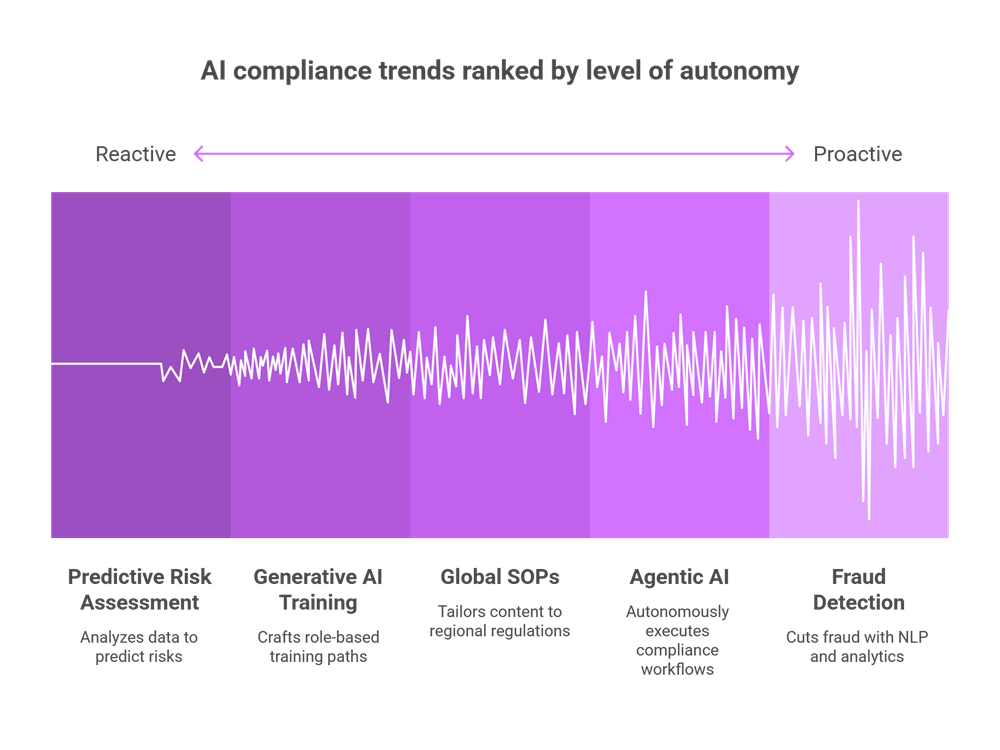
Top Trends Shaping Compliance in 2025 and Beyond

The AI compliance landscape is evolving rapidly. Here is what to watch:

Top Trends Shaping Compliance

  • Predictive Risk Assessment: Move beyond reactive audits. AI analyzes historical data to predict risks like adverse events or regulatory shifts, with tools spotting patterns in 80 percent less time. By 2026, expect more than half of organizations piloting AI for this, up from current levels.
  • Generative AI for Personalized Training: Forget generic modules. AI crafts role-based paths, boosting retention by 35 percent and reducing violations from knowledge gaps. In 2025, nearly half of U.S. organizations are early adopters of gen AI here.
  • Global SOPs with Local Twists: AI navigates cross-border regs, generating compliant content tailored to regions. This is crucial as a large majority of hospitals now use AI for operational tweaks.
  • Agentic AI and Automation: Emerging “agentic” systems autonomously plan and execute compliance workflows, like auto-updating policies post-regulatory changes. These are poised to dominate by 2028.
  • Fraud Detection and Privacy Boosts: With interconnected systems rising, AI’s NLP and analytics will cut fraud, waste, and abuse by 20 to 25 percent, but demand ironclad encryption to meet 2027 interoperability mandates.


Insight: AI adoption in healthcare leads all industries, with nearly all leaders viewing it as core to strategy. Yet only about two-thirds of physicians are fully onboard, highlighting a training gap to bridge.

Also Read: Innovations in Healthcare Software: Transforming the Future

Hurdles on the Horizon: Navigating AI’s Dark Side

AI is not flawless. Data bias can skew risk predictions, potentially amplifying disparities in underserved communities. Privacy risks loom large with gen AI’s data hunger, and implementation costs can hit six figures for mid-sized setups. Plus, evolving regs, like the EU AI Act, require “explainable AI” to avoid black-box fines.

The fix? Start small, audit algorithms regularly, and partner with compliant vendors. As one compliance expert notes, “AI amplifies human judgment. Do not replace it.” By addressing these, organizations can turn challenges into compliance edges.

Looking Ahead: A Compliant Tomorrow

By 2030, AI could automate 80 percent of compliance tasks, freeing professionals for strategic roles and cutting global fines by billions. The future? Smarter, safer healthcare where tech safeguards trust.

Ready to future-proof your program? Assess your stack against these tools, pilot one trend, and track ROI quarterly. Your patients, and your bottom line, will thank you. What is your first AI move? Share in the comments!

How to Build AI Software

Artificial Intelligence (AI) has become a transformative force in modern business. From predictive analytics to intelligent automation, companies are using AI to streamline operations, improve decision-making, and drive growth.

However, not every AI project leads to success. In fact, Gartner reports that up to 85% of AI initiatives fail to deliver measurable business value.

The real challenge lies in developing AI software that addresses specific business needs rather than just adopting AI for the sake of innovation.

This guide explains how to build AI software that actually solves business problems, step by step, based on practical, data-backed strategies.

What Is AI Software in a Business Context?

AI software refers to systems that use data-driven algorithms to simulate human intelligence and improve over time through learning. In business, AI software is applied in areas such as:

  • Automating repetitive tasks
  • Analyzing large volumes of data
  • Enhancing customer experiences
  • Detecting anomalies or fraud
  • Improving predictive accuracy for decision-making


When designed correctly, AI tools can increase efficiency, reduce costs, and generate insights that directly support business growth. Companies that partner with reliable Offshore Software Development services often gain access to advanced AI expertise at competitive costs, helping them scale AI initiatives faster.

Step 1: Identify the Real Business Problem

Before building any AI solution, start with a clear problem definition. Avoid focusing on the technology first.

Ask these key questions:

  • What bottlenecks or inefficiencies exist in the current workflow?
  • Which repetitive or data-intensive processes can AI optimize?
  • How will solving this challenge impact revenue, efficiency, or customer satisfaction?


Example: Instead of saying “We need an AI chatbot,” define it as “We want to reduce customer service response time by 60%.

Insight: According to McKinsey & Company, organizations that align AI projects with clear business goals achieve up to 3x higher ROI compared to those without strategic alignment.

Step 2: Gather and Prepare High-Quality Data

Data is the foundation of AI success. Poor data quality leads to inaccurate predictions and unreliable outcomes.

Follow these steps for effective data preparation:

  • Aggregate: Collect data from verified internal and external sources.
  • Clean: Remove duplicates, handle missing values, and standardize formats.
  • Label: Tag data correctly for supervised learning tasks.
  • Secure: Ensure compliance with GDPR, CCPA, or local data privacy regulations.


If data is limited, consider using synthetic data generation to train models effectively without compromising accuracy.

Step 3: Choose the Right AI Approach and Technology Stack

Different business challenges require different AI techniques. Selecting the right model is essential for achieving accurate results.

Popular AI approaches include:

  • Machine Learning (ML): Predictive analytics, fraud detection, customer segmentation
  • Natural Language Processing (NLP): Chatbots, voice assistants, sentiment analysis
  • Computer Vision: Image recognition, quality inspection, facial authentication
  • Deep Learning: Advanced modeling for unstructured data such as audio or video

Technology stack recommendations:

  • Frameworks: TensorFlow, PyTorch, Scikit-learn
  • Cloud Platforms: AWS AI/ML, Google Cloud AI, Azure Machine Learning
  • Deployment Tools: Docker, Kubernetes, FastAPI

Businesses seeking to leverage these tools often collaborate with a custom software development company in USA that specializes in end-to-end AI implementation, ensuring technical precision and compliance with modern development standards.

Step 4: Build a Cross-Functional AI Team

A successful AI project depends on collaboration between technical and non-technical experts.

Your ideal AI development team should include:

  • Data Engineers to collect and organize data
  • Machine Learning Engineers to design and train modelsBuild a Cross-Functional AI Team
  • Domain Experts to align AI outcomes with business needs
  • UI/UX Designers to make AI results actionable
  • Project Managers to oversee timelines and deliverables

Stat: PwC reports that companies with cross-functional AI teams are 2.5 times more likely to achieve scalable business outcomes.

Step 5: Develop, Test, and Continuously Improve the Model

AI model development should be iterative. Build small prototypes, test frequently, and refine based on feedback.

Key phases include:

  • Data preparation and training
  • Model testing using evaluation metrics (precision, recall, F1-score)
  • Validation on real-world data
  • Continuous optimization for better performance


Always monitor model drift, which occurs when real-world data patterns change, reducing model accuracy over time.

Step 6: Integrate AI Software with Existing Systems

To be effective, AI software must integrate seamlessly with current workflows and digital infrastructure.

Integration best practices:

  • Use APIs for data exchange and communication between systems
  • Ensure compatibility with CRM, ERP, and other business tools
  • Create user-friendly dashboards for real-time insights


A well-integrated system ensures faster adoption and higher productivity across teams. Partnering with an experienced LLM development company can help businesses integrate large language models into existing workflows for improved automation, customer interaction, and data processing capabilities.

Step 7: Ensure AI Ethics, Fairness, and Explainability

Trust is essential in AI adoption. Stakeholders should understand how decisions are made by the system.

Best practices for ethical AI:

  • Use Explainable AI (XAI) models to show how results are generated
  • Regularly audit for bias and ensure fair outcomes
  • Maintain compliance with AI governance and data ethics standards


Insight: IBM Research found that 91% of companies using explainable AI report higher stakeholder trust and adoption rates.

Step 8: Define Clear KPIs to Measure Success

Without measurable KPIs, you cannot evaluate AI performance effectively.

Track key metrics such as:

Clear KPIs to Measure Success

  • Operational efficiency: Reduction in processing or response times
  • Revenue impact: Increase in sales or lead conversion
  • Cost optimization: Savings through automation
  • Customer satisfaction: Higher Net Promoter Score (NPS)

Establishing these KPIs ensures your AI system stays aligned with real business objectives.

Step 9: Scale, Monitor, and Maintain the AI Solution

Once the AI solution proves successful in a pilot phase, scale it across the organization.

Maintenance checklist:

  • Retrain models regularly with updated data
  • Monitor performance for accuracy and relevance
  • Implement cloud-based scaling for flexibility
  • Update for regulatory compliance and cybersecurity standards

Long-term success depends on continuous monitoring and proactive improvements.


custom software development company in USA

Key Takeaway: Building AI Software That Delivers Real Results

Developing AI software that truly solves business problems requires more than technical skills, it demands strategic clarity, clean data, ethical transparency, and ongoing optimization.

As AI adoption continues to grow, with IDC projecting global AI spending to reach $500 billion by 2027, now is the time to invest strategically.

Businesses that approach AI with a clear purpose and a data-driven mindset will be better positioned to increase efficiency, enhance decision-making, and achieve long-term competitive advantage.

Final Thought

AI success is not about how advanced your algorithms are, but about how effectively your software transforms business outcomes. Start small, stay focused on measurable results, and scale with confidence.

Frequently Asked Questions (FAQs)

1. What makes an AI project successful in business?

A successful AI project starts with a clear goal, uses clean data, aligns with business strategy, and includes measurable KPIs.

2. How long does it take to build AI software?

Depending on complexity and data availability, developing AI software typically takes between 3 to 9 months, including testing and deployment.

3. What is the biggest reason AI projects fail?

Most AI projects fail due to poor data quality, unclear objectives, or lack of integration with existing business systems.

4. How can small businesses benefit from AI?

Small businesses can use AI for automating customer service, analyzing sales trends, optimizing marketing, and improving inventory management.